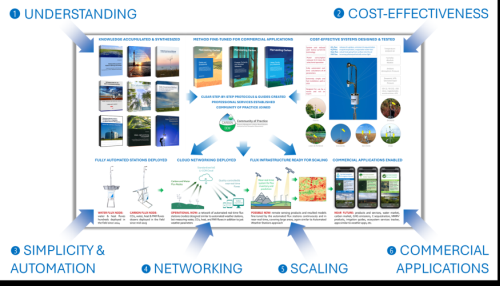
From Long-Term Flux Observation and Ecosystem Research Networks to Individual Applications - Benefits to Science and Society
Co-sponsored by
ICOS
Convener:
Andreas Ibrom
|
Co-conveners:
George Burba,
Alexander Graf,
Natalia Kowalska,
Kaido Soosaar,
Marilyn Roland,
Dario Papale
Orals
|
Mon, 04 May, 10:45–12:30 (CEST) Room 2.23
Posters on site
|
Attendance Mon, 04 May, 14:00–15:45 (CEST) | Display Mon, 04 May, 14:00–18:00 Hall X1
The first part of the session provides:
• A discussion platform to exchange the state-of-the-art and novel developments in such long-term research networks
• Recognition of the multiple values of these networks for science and society
• Mutual interaction between users, networks organisers, and stations
Specific topics are :
1. Characteristics and challenges of long-term measurements in research networks: e.g., adaptation to change (scientific progress, technology change, and scopes), data harmonisation, new methods and procedures, attribution of ecosystem changes to external versus internal factors.
2. Scientific results specific to the analysis of long-term data: among others, e.g,. temporal scales of change: climate change, trends and variability, role of network products for synthesis studies
3. Synergy from collaboration with other scientific communities (e.g. collocation with other networks, campaign studies, scientific studies)
4. Sustainability and purposes to society – dialogue with stakeholders and users, participation
The second part focuses on using flux measurements for immediate societal benefits:
• Most of the ongoing GHG measurements are used for important discoveries achieved through process-level academic studies, and for long-term climate and ecosystem modeling. Most of the water measurements at the GHG flux sites are used for applications of computing and interpreting ecosystem-level GHG exchange.
• Such measurements use ultra-high-resolution methodology and state-of-the-art hardware vastly superior to typical monitoring-grade methods and equipment deployed outside academia for a wide range of non-academic decision-making applications, from gas leaks to drought or heat wave detections. However, despite providing exceptional ways to measure GHG emissions and ET, direct flux measurements are very rarely utilized outside academia.
This part of the session, organized through research-industry collaborations, presents new ideas and existing examples of how to better utilize direct flux measurements for immediate societal benefits.
10:45–10:50
5-minute convener introduction
10:50–11:00
|
EGU26-20887
|
Highlight
|
On-site presentation
11:10–11:20
|
EGU26-10984
|
On-site presentation
11:20–11:30
|
EGU26-17755
|
On-site presentation
11:30–11:40
|
EGU26-6292
|
On-site presentation
11:40–11:50
|
EGU26-17104
|
Virtual presentation
11:50–12:00
|
EGU26-72
|
ECS
|
On-site presentation
12:00–12:10
|
EGU26-330
|
ECS
|
Virtual presentation
12:10–12:20
|
EGU26-8987
|
ECS
|
On-site presentation
12:20–12:30
|
EGU26-9210
|
ECS
|
On-site presentation