GD2.6 | Lithosphere structure and evolution worldwide with focus on the Tethyan Belt
EDI
Lithosphere structure and evolution worldwide with focus on the Tethyan Belt
Co-sponsored by ILP
Convener: Alexey Shulgin | Co-conveners: Hans Thybo, Nalan Lom, Irina M. Artemieva, Bo WanECSECS, Xiaoqing Zhang
Orals
| Fri, 08 May, 14:00–18:00 (CEST)
 
Room -2.21
Posters on site
| Attendance Fri, 08 May, 10:45–12:30 (CEST) | Display Fri, 08 May, 08:30–12:30
 
Hall X2
Posters virtual
| Thu, 07 May, 14:09–15:45 (CEST)
 
vPoster spot 3, Thu, 07 May, 16:15–18:00 (CEST)
 
vPoster Discussion
Orals |
Fri, 14:00
Fri, 10:45
Thu, 14:09
The session topic is interpretation and modelling of the geodynamic processes in the lithosphere-asthenosphere system and the interaction between crust and lithospheric mantle, as well as the importance of these processes for the formation of the discontinuities that we today observe in the crust and mantle. We aim at establishing links between seismological observations and process-oriented modelling studies to better understand the relation between present-day fabrics of the lithosphere and contemporary deformation and ongoing dynamics within the asthenospheric mantle.

The Tethyan Belt is the most prominent collisional zone on Earth, covering the vast area between far eastern Asia and Europe. The Tethyan Belt is the result of the subduction of the Tethyan Oceans, including significant terrane amalgamation, and collisional tectonics along the whole belt. The belt is today strongly affected by the ongoing convergence and collision between the Eurasian, African, Arabian and Indian plates. The long formation history and the variability of tectonic characteristics and deep structures of the belt make it a natural laboratory for understanding the accretion processes that have shaped the Earth through its history and have led to the formation of vast resources in the crust.

We invite contributions based on geological, tectonic, geophysical and geodynamic studies of the lithosphere. We particularly invite interdisciplinary studies, which integrate observational data and interpretations based on a variety of methods. Papers with focus on the structure of the crust and the nature of the Moho are also welcome.

Orals: Fri, 8 May, 14:00–18:00 | Room -2.21

The oral presentations are given in a hybrid format supported by a Zoom meeting featuring on-site and virtual presentations. The button to access the Zoom meeting appears just before the time block starts.
Chairpersons: Hans Thybo, Alexey Shulgin, Nalan Lom
14:00–14:05
14:05–14:15
|
EGU26-17318
|
On-site presentation
Yongjiang Liu, Franz Neubauer, Qianwen Huang, Qingbin Guan, Johann Genser, Boran Liu, Sihua Yuan, and Ruihong Chang

The Austroalpine basement in the eastern Alps underwent Proto-Tethys and Paleo-Tethys tectonic evolution. To restore the tectonic processes of Proto-Paleo-Tethys Ocean in the eastern Alps, we carried out a systematic study by U-Pb zircon geochronology and geochemistry. In the Schladming Complex our study shows that the granodioritic gneisses (539-538 Ma) with A2-type geochemical signature and the fine-grained amphibolite (531 Ma) with E-MORB affinity, represent a bimodal magmatism. A medium-grained amphibolite (495 Ma) exhibits OIB-like geochemical features. The monzonite granitic gneiss (464 Ma) and plagioclase gneiss (487 Ma) have volcanic arc geochemical features. In Speik-Gleinalpe Complex the amphibolites (489-496 Ma), granitic gneiss (491 Ma) and plagiogneiss (472-476 Ma) all have subduction-related geochemical signatures. These all magmatism recorded the subduction and back-arc basin tectonic processes of Proto-Tethys Ocean.

In Schladming Complex we found that the overgrowth rims of zircons of the early Paleozoic biotite-plagioclase gneiss and granitic gneisses give a dominantly metamorphic age of ca. 355 Ma. In addition, the zircons from the samples of Speik-Gleinalpe also yield a metamorphic age of ca. 400 Ma. In the Schladming Complex we also dated two granites with crystallization age of 353-355 Ma, which have subduction-related geochemical characteristics. These Devonian-Carboniferous metamorphism and magmatism together indicate that the Austroalpine basement had been overprinted by the Variscan orogeny.

In the southern and western Saualpe crystalline basement, the three amphibolites yield crystallization ages of 415-418 Ma and have similar geochemical signature of OIB. We suggest that the Late Silurian-earliest Devonian OIB-like magmatism was related to a back-arc extension setting along the northern margin of Gondwana and indicating the opening of the Paleo-Tethys Ocean.

In the Plankogel Complex we found two N-MORB amphibolites exhibit late Permian/Early Triassic protolith ages (254-227 Ma), representing the Paleo-Tethys oceanic crust relics. The manganese quartzites are explained as siliceous deep-sea sediments with a large Permian to Early Triassic (244-282 Ma) volcanic components. We interpret the Plankogel Complex as an ophiolitic complex of Paleo-Tethys suture.  

Based on our studies above we restore the tectonic evolution of Proto-Paleo-Tethys Ocean in the eastern Alps: The basement complexes in the eastern Alps had been a part of the active continental margin of Gondwana. With the subduction of the Proto-Tethys oceanic plate to the south, a back-arc rift developed along the northern margin of the Gondwana in the Early Cambrian, resulted in the opening of a back-arc basin (Speik Ocean) and the break-off of the proto-E Alps terranes from Gondwana in the Late Cambrian. In the Early Ordovician the proto-E Alps terranes collided back to the Gondwana with the closure of Speik Ocean. During the Late Silurian-earliest Devonian the Paleo-Tethys Ocean opened as back-arc basin due to southward subduction of Rheic Ocean, resulting in the break-off of the proto-south-Europe marginal terranes from the northern margin of Gondwana. From Late Devonian to Early Carboniferous the break-off terranes drifted northward and accreted to the southern margin of European continent with the consuming and closure of Rheic Ocean. In the Late Permian-Middle Triassic the Paleo-Tethys Ocean was closed after continuing northward subduction.

How to cite: Liu, Y., Neubauer, F., Huang, Q., Guan, Q., Genser, J., Liu, B., Yuan, S., and Chang, R.: Tectonic evolution of Proto-Paleo-Tethys Ocean in the eastern Alps, EGU General Assembly 2026, Vienna, Austria, 3–8 May 2026, EGU26-17318, https://doi.org/10.5194/egusphere-egu26-17318, 2026.

14:15–14:25
|
EGU26-309
|
On-site presentation
William Cavazza, Claudio Faccenna, Massimiliano Zattin, Carla Braitenberg, Paolo Ballato, Aral I. Okay, Gültekin Topuz, Sveva Corrado, Paola Molin, Victor Alania, Onise Enukidze, Thomas Gusmeo, Andrea Schito, Ghazar Galoyan, Nazim Imamverdiyev, Irene Albino, Silvia Cattò, and Andrea Sembroni

We present the main results of a multidisciplinary study assessing geological, geophysical and geomorphological signals induced by lithosphere and/or deep mantle dynamics on the morphotectonic evolution along a ca. 700 km-long traverse stretching from the Greater Caucasus, across the Lesser Caucasus and eastern Anatolia, into the Arabia-Eurasia suture zone and the northernmost Arabian platform. The results define a complex history punctuated by sequential terrane accretion and incremental deformation culminating in the Arabia-Eurasia collision and the coeval deformation of a wide swath of the European hinterland.

The inversion of the prominent positive linear anomalies of the regional gravity field defines discrete crustal density inhomogeneities, which can be interpreted as related to specific tectonic events, thus placing cogent constraints on the accretionary history and the overall anatomy of the eastern Anatolian-Caucasian lithospheric agglomerate. Three linear belts of intracrustal increased density mark the presence of suture zones along (i) the Greater Caucasus, (ii) the Lesser Caucasus, and (iii) a previously unidentified parallel belt ca. 80 km south of the Lesser Caucasus. The latter gravity anomaly delineates the southwestern margin of the South Armenian Block, a lithospheric element (microplate) whose existence has long been a matter of debate.

In the Caucasian domain intraplate deformation was triggered by far-field propagation of plate-margin collisional stress which focused preferentially along rheologically weak zones such as the Greater Caucasus and the adjacent Adjara-Trialeti fold-and-thrust belt of Georgia, two intraplate orogens produced by structural inversion of parallel continental rift zones located on the Eurasian plate. The integration of multiple thermochronometric techniques and peak-temperature determinations shows that structural inversion was punctuated by two incremental steps starting in the Late Cretaceous and the mid-Miocene. The two episodes of intraplate structural inversion, exhumation, and sediment generation are chronologically and physically correlated with the docking of (i) the South Armenian microplate and the Anatolide-Tauride-Armenian terrane (Late Cretaceous - Paleocene) and (ii) Arabia (Miocene hard collision) against the southern Eurasian plate margin.

As to the Lesser Caucasus of Armenia and Azerbaijan, the thermochronologic record of the Late Cretaceous cooling/exhumation event is still present only in a relatively small area of the upper plate of the Amasia-Sevan-Akera (ASA) suture zone where later exhumation has been thermochronologically insignificant. More commonly, rapid cooling/exhumation, which occurred in the Early-Middle Miocene in both the lower and upper plates of the ASA suture zone, has overprinted and obscured previous thermochronologic signatures. Miocene contractional reactivation of the ASA suture zone occurred contemporaneously with the main phase of shortening and exhumation along the Bitlis suture zone marking the Arabia-Eurasia hard collision.

The elevation of marine deposits across the eastern Anatolian Plateau indicates a post-collisional surface uplift of ∼2,000 m. This uplift occurred in two steps: (i) at 10–11 Ma with the opening of a slab window and the concomitant arrival of a mantle flow from Arabia, both processes supporting dynamically the topography, and (ii) at ∼5 Ma with the continued inflow coupled with the isostatic response to the ongoing crustal shortening.

How to cite: Cavazza, W., Faccenna, C., Zattin, M., Braitenberg, C., Ballato, P., Okay, A. I., Topuz, G., Corrado, S., Molin, P., Alania, V., Enukidze, O., Gusmeo, T., Schito, A., Galoyan, G., Imamverdiyev, N., Albino, I., Cattò, S., and Sembroni, A.: The Caucasian-Anatolian Geotraverse: sequential terrane accretion and incremental intraplate deformation in the hinterland of the Arabia-Eurasia suture zone., EGU General Assembly 2026, Vienna, Austria, 3–8 May 2026, EGU26-309, https://doi.org/10.5194/egusphere-egu26-309, 2026.

14:25–14:35
|
EGU26-8072
|
On-site presentation
Mahdi Najafi, Jaume Vergés, David Cruset, Philippe Razin, Marc Viaplana-Muzas, Montserrat Torne, Daniel García-Castellanos, Ana M. Negredo, Vincenzo Spina, Manel Fernàndez, and Ivone Jiménez-Munt

In this study, we present new regional, crustal-scale, balanced and restored cross-sections across the central Oman Mountains to refine the structural style and reconstruct the kinematic evolution of subduction-driven obduction and subsequent mountain building since the Albian–Cenomanian boundary. The present-day cross-section constrains footwall ramp locations in both autochthonous and allochthonous domains, allowing estimates of the minimum original lengths of paleogeographic units. It also identifies four major detachment levels that exert key controls on both allochthonous nappe emplacement and autochthonous crustal deformation: (a) the Semail Ophiolite detachment and its metamorphic sole; (b) the Hawasina detachment developed along the syn-rift to post-rift unconformity within the Hawasina Basin; (c) the mid-crustal flat–ramp–flat, thick-skinned thrust beneath Jabal Akhdar at ~15 km depth, likely inherited from Paleozoic orogenic events; and (d) the Early Cambrian Ara Salt detachment at 4–5 km depth in the Fahud foreland basin. Integration of balanced and restored cross-sections with tectono-stratigraphic, tectono-metamorphic, and geochronological constraints allows the definition of three evolutionary stages: (1) a pre-obduction stage (Albian–Cenomanian boundary to 95.2 Ma), characterized by NE-dipping intra-oceanic subduction and slab rollback (events 1–2); (2) an obduction stage (~95.2–80 Ma), marked by emplacement of the Semail Ophiolite and Hawasina nappes onto the Oman margin (events  3–5); and (3) a post-obduction mountain-building stage since Campanian times (event 6). This kinematically constrained reconstruction of the Semail Ophiolite and Hawasina nappes offers a reference framework for interpreting other obduction systems worldwide, particularly along most segments of the Alpine–Himalayan orogenic belt where geological exposure has been overprinted by subsequent continental collision.

How to cite: Najafi, M., Vergés, J., Cruset, D., Razin, P., Viaplana-Muzas, M., Torne, M., García-Castellanos, D., M. Negredo, A., Spina, V., Fernàndez, M., and Jiménez-Munt, I.: Kinematic Modeling of Subduction, Obduction, and Mountain-Building Geodynamic Processes in Central Oman, EGU General Assembly 2026, Vienna, Austria, 3–8 May 2026, EGU26-8072, https://doi.org/10.5194/egusphere-egu26-8072, 2026.

14:35–14:45
|
EGU26-8595
|
On-site presentation
Yajin Pang

Under continuous continental collision of the Indian and Eurasia plates, several N-S rifts are widely distributed in southern Tibet, indicating the predominant E-W extension. The E-W extension is one of the most remarkable tectonic features in the Tibetan Plateau. Hypotheses including gravitational collapse, India-Eurasia continental collision, underthrusting of Indian lower crust, and crustal flow are proposed. However, the relative roles of each driving force remain controversial due to lack of a unified model. Here, we have developed a high-resolution 3D numerical model, integrating multiple tectonic factors including India-Eurasia continental collision, underthrusting Indian lower crust, gravitational collapse as well as discontinuously distributed weak mid-crustal zones, to simulate the crustal deformation in southern Tibet. The integrated muti-force model produces crustal deformation consistent with GNSS horizontal velocities and strain rates in southern Tibet. In details, India-Eurasia continental collision can cause not only N-S compression but also smaller E-W extension in southern Tibet. The underthrusting process of rigid Indian lower crust could reduce the N-S compression in its overlying upper crust caused by continental collision. Gravitational collapse leads to pronounced extension in southern Tibet, which can not only generate E-W extension, but also resist N-S compression from continental collision along with Indian lower crust underthrusting. Notably, the local weak mid-crustal zones in the east part of southern Tibet flows faster driven by gravitational collapse, which enhances E-W extension in the upper crust and locally decouples the underthrusting Indian lower crust and Tibetan upper crust. Overall, the predominant E-W extension in southern Tibet is jointly controlled by gravitational collapse, India-Eurasia continental collision along with Indian lower crust underthrusting, and local weak mid-crustal zones. India-Eurasia continental collision has contributed to the regional E-W extension throughout the southern Tibet, while gravitational collapse has played a significant role in enhancing E-W extension rates in the east part.

How to cite: Pang, Y.: The formation of E-W extension in southern Tibet: from an integrated geodynamic model, EGU General Assembly 2026, Vienna, Austria, 3–8 May 2026, EGU26-8595, https://doi.org/10.5194/egusphere-egu26-8595, 2026.

14:45–14:55
|
EGU26-4580
|
On-site presentation
Di Xin, Tian-Nan Yang, and Ming-Juan Liang

The northward subduction of the Neo-Tethys oceanic plate beneath Eurasia has led to the development of a substantial continental margin arc belt with a length of > 10,000 km along the southern margin of Eurasia. The indentation of India Continent into Eurasia resulted in the widespread segmentation of this substantial Andean-type subduction system. The Gangdése and the Myanmar-Tengchong arc belts are two such segments. A comparison of the subduction process of the Myanmar-Tengchong magmatic belt with that of the Gangdése arc belt reveals a high degree of similarity. However, in the Southeastern Tibet, the formation of the Myanmar-Tengchong magmatic belt from the Jurassic to the late Cretaceous period is debated due to the incomplete tectonic facies succession. Thus, our study focus on the spatial distribution of tectonic facies within the Myanmar-Tengchong belt. The detailed field studies, zircon U-Pb and bulk 40Ar/39Ar dating results, bulk geochemistry, and Sr–Nd isotopic data contributed to the identification of a late Early Cretaceous volcanic succession in a region to the east of the Myanmar-Tengchong magmatic belt. This volcanic succession consists of basalt, basaltic andesite, andesite with minor amount of dacite, intercalated with clastic and limestone rocks. This volcaniclastic succession had previously been interpreted as being of Carboniferous or Triassic age. However, the dating of zircons from five andesite samples and the 40Ar/39Ar dating results of groundmass from two basalt samples suggest that the volcanic succession likely erupted at about 106 Ma, during the Late Cretaceous Albian Age. The basalts from the volcanic succession exhibit characteristics of back-arc basin basalt, while the sedimentary rocks demonstrate features of a shallow marine face. These findings suggest that this succession represents the remnant of a back-arc basin spanning a period from 120 to 106 Ma, which is the northward extension of a Late Cretaceous back-arc basin in the southern part of the southeastern Tibet. The subduction process of the Neo-Tethys well is constrained by the north-south extending back-arc basin and the Myanmar-Tengchong magmatic belt. In the early stage, the Neo-Tethys oceanic plate subducted beneath Eurasia at a normal angle, resulted in a continental margin magmatic arc. Since ca.120 Ma, the rolling back of the subducted oceanic slab produced a back-arc basin behind the continental arc. From ca.106-77 Ma, the hinter segment of the subducted oceanic slab initiated a process of flat subduction, likely due to the break-off of the rolled segment of the subducted oceanic slab. Meanwhile, the arc-magmatism was very weak, and the extensional back-arc basin inverted to a compressional retro-arc foreland basin. After ca.77 Ma, the subduction angle became normal again, marking the onset of another period of intense magmatism started. This tectonic model likely shed lights on the subduction process that defined the Gangdése magmatic arc. It is possible that the back-arc basin, situated east of the Myanmar-Tengchong magmatic belt, is comparable to the northern Lhasa, where the Early Cretaceous marine sequences intercalated with bimodal volcanic rocks are common and have been interpreted as back-arc rift basins by some studies.

How to cite: Xin, D., Yang, T.-N., and Liang, M.-J.: A Back-arc Basin of Neo-Tethys in Southeastern Tibet, EGU General Assembly 2026, Vienna, Austria, 3–8 May 2026, EGU26-4580, https://doi.org/10.5194/egusphere-egu26-4580, 2026.

14:55–15:05
|
EGU26-16035
|
ECS
|
On-site presentation
Huiyan Zhang, Letian Zhang, Sheng Jin, Wenbo Wei, and Gaofeng Ye

The central Songpan-Ganze terrane is located in the central northern Tibetan Plateau. It borders the Qaidam Basin to the north, with the Kunlun fault marking their boundary. In the south, it is bounded by the Jinsha suture zone and borders the Qiangtang terrane to the south. A large number of left-lateral strike-slip faults have been mapped within the Songpan-Ganze terrane, showing that the shear strain is distributed over the entire block, and the crust shows the trend of eastward migration. Currently, it is still debated whether the mechanism of crust-mantle deformation and material migration of the Songpan-Ganze region is dominated by the vertical process of asthenosphere upwelling or the horizontal shearing process related to lateral extrusion. To further explore the deep dynamic mechanism, 192 broadband and long-period MT sites collected under the SinoProbe and INDEPTH projects are used to investigate the electrical structure of the crust and upper mantle beneath the central Songpan-Ganze terrane. By processing and analyzing the measured MT data, and using the LBFGS algorithm for three-dimensional (3-D) inversion, a reliable 3-D electrical structure model is derived. The deep electrical structure is analyzed and interpreted by integrating with other background geological and geophysical data. The following preliminary conclusions are drawn:  (1) Under the Ganze-Yushu sinistral strike-slip fault within the Songpan-Ganze terrane, there are a series of low-resistivity channels extending northward in the middle and lower crust, which correspond to the "finger" shaped low-resistivity intrusions under the Kunlun fault, indicating that these "finger" shaped conductors have already been developed within the Songpan-Ganze terrane, and may be related to large-scale sinistral strike-slip deformation in the region. (2) These low-resistivity channels exhibit relatively weak lateral connectivity but demonstrate significant vertical extent, indicating that the deformation mechanisms in the vertical direction within the study area cannot be ignored. This phenomenon is likely closely related to the rheological structure of the block and suggests that the upwelling of mantle-derived thermal materials may play a crucial role in the regional tectonic evolution. (3) The low-resistivity body in the central Songpan-Ganze region gradually narrows from west to east, with its eastern portion exhibiting an upward extension into the upper crust. This may indicate that the Songpan-Ganze terrane experienced heterogeneous stress during the process of accommodating tectonic deformation between the Qiangtang terrane and the Qaidam Basin. As a result, the eastern part of the study area was subjected to greater compressive stress, leading to upward thrusting and the formation of a high-angle thrust conductor.

*This research is funded by The China Magnetotelluric Array (Phase I), National Science and Technology Major Project (2024ZD1000202), Deep Earth Probe and Mineral Resources Exploration - National Science and Technology Major Project (2024ZD1000106-04) and NSFC (42074089).

How to cite: Zhang, H., Zhang, L., Jin, S., Wei, W., and Ye, G.: Inferring the Regional Dynamics of Central Songpan-Ganze Terrane Informed by Magnetotelluric Data from the Northern Tibetan Plateau, EGU General Assembly 2026, Vienna, Austria, 3–8 May 2026, EGU26-16035, https://doi.org/10.5194/egusphere-egu26-16035, 2026.

15:05–15:45
Coffee break
Chairpersons: Irina M. Artemieva, Bo Wan, Xiaoqing Zhang
16:15–16:25
|
EGU26-11572
|
On-site presentation
Eric Debayle and Yanick Ricard

High seismic velocity keels extending to depths greater than 200 km underlie the oldest parts of continents, the Precambrian cratons. These keels have probably been formed early in Earth’s history, and the preservation of these deep, cold, and highly viscous roots in a convective mantle remains enigmatic. A classical view is that the excess density due to colder temperatures is compensated for by a light composition. Here, we map the magnesium number (Mg#, a proxi for mantle depletion) within cratonic keels, based on the thermochemical interpretation of a global shear velocity model. Our interpretation suggests that depletion is strong above 150 km (Mg#>92), and decreases with depth down to the lithosphere-asthenosphere boundary (LAB). Below the graphite/diamond transition, the combination of depletion with a low volume fraction of diamond (<1% at 150 km) is necessary to explain the very high shear velocities, while maintaining the cratonic lithosphere close to neutral buoyancy. Our results suggest that a small amount of diamonds is present in the deep part of continental roots, particularly beneath Australia, North America, South Africa, Scandinavia, and Antarctica. Their presence is not exclusively linked to volcanism on the periphery of cratons, where they have been discovered at the surface.

How to cite: Debayle, E. and Ricard, Y.: Seismic evidence for the presence of diamonds in the deepest parts of continental roots, EGU General Assembly 2026, Vienna, Austria, 3–8 May 2026, EGU26-11572, https://doi.org/10.5194/egusphere-egu26-11572, 2026.

16:25–16:35
|
EGU26-15581
|
On-site presentation
Lijun Liu, Xinyu Li, Zebin Cao, Yanchong Li, and Bo Wan

Driving forces of plate tectonics remain a fundamental question of geodynamics. Traditional research on this topic heavily replies on theoretical analysis or simple numerical experiments with assumptions that may not be applicable to the real Earth. For example, the concept of slab pull assumes that the total negative buoyancy of the upper-mantle slab readily transmits to the tectonic plate at the surface, while in reality most of this force would be accommodated by the disturbed ambient mantle. In addition, many numerical models evaluating plate driving forces usually assume a regional geometry and neglect the dynamic effects of other subduction systems. More importantly, most previous studies investigating plate driving forces used plate kinematics as key constraints and failed to provide quantitative force measurements.

We revisit the driving mechanisms of plate motion and intraplate tectonism using state-of-the-art 4D global convection models with data assimilation that simultaneously consider all subduction systems according to recent plate reconstructions. These models also utilize realistic rheology and convection vigor, implemented on a high-resolution (locally achieving ~5 km) numerical mesh. We avoided any analytical approximation by directly measuring the values of various forces predicted from the model. We find that most of the negative buoyancy of the slab fails to transmit to the surface plate. On the other hand, lateral pressure gradients widely exist inside the mantle that present a previously unrecognized driving mechanism for various surface tectonism. The pressure gradient across the slab hinge provides a force that usually points in the direction of subduction and plate motion. In major continental collision zones, even without the presence of active subduction, this force may sustain the surface convergence by dragging the underside of lithosphere. Temporally, this lateral pressure gradient grows as subduction continues, reducing the slab dip angel and eventually tearing the young slab. Then prominent landward mantle wind occurs that further interacts with the overriding continent to form complex intraplate processes.

How to cite: Liu, L., Li, X., Cao, Z., Li, Y., and Wan, B.: Mantle pressure gradient as a novel driver for plate motion and intraplate tectonism, EGU General Assembly 2026, Vienna, Austria, 3–8 May 2026, EGU26-15581, https://doi.org/10.5194/egusphere-egu26-15581, 2026.

16:35–16:45
16:45–16:55
|
EGU26-10116
|
ECS
|
On-site presentation
Sinan Ozaydin, Federico Munch, and Alexander Grayver

The western United States is characterized by an exceptional diversity in volcanic and tectonic styles within a relatively compact region, including active subduction beneath the Cascade Arc, potential hotspot volcanism along the Yellowstone–Snake River Plain track, and widespread extension across the Basin and Range Province. Such diversity settings, along with excellent geophysical data enables quantitative studies on how lithospheric architecture and mantle properties control magma generation. Yet, most existing geophysical studies have treated these provinces in isolation and relied on single-method interpretations that struggle to resolve temperature, composition, melt fraction, and volatile content. 

Multi-scale electrical conductivity models of the United States based on the recently completed USArray magnetotelluric survey have reached a level of maturity and a resolution comparable to that of seismic tomography models offering unique insights into fluids, melts, and compositional variations. In this contribution, we present an integrated analysis of mantle structure across the western US, spanning from the Yellowstone Plateau to the Pacific margin, using complementary constraints from electrical conductivity and seismic tomography models as well as thermal constraints independently-derived from xenolith thermobarometry. Combining these datasets within a probabilistic framework enables us to separate the effects of temperature, water content, composition, and partial melt that individually may produce non-unique signatures. 


How to cite: Ozaydin, S., Munch, F., and Grayver, A.: Integrating Magnetotelluric and Seismic Observations to Constrain Mantle Composition, Hydration, and Melt Distribution Beneath the Western United States., EGU General Assembly 2026, Vienna, Austria, 3–8 May 2026, EGU26-10116, https://doi.org/10.5194/egusphere-egu26-10116, 2026.

16:55–17:05
|
EGU26-1345
|
On-site presentation
Yiping Zhang

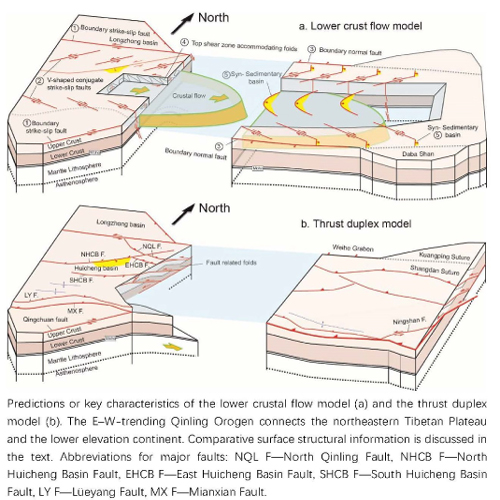
The E–W-trending Qinling Orogen lies in the transitional zone between the northeastern extent of the Tibetan Plateau and the lower-elevation portion of the continent. This region is suggested to have accommodated flow of the low-viscosity lower crust from the Tibetan Plateau northward around the Sichuan Basin during the Cenozoic Himalayan–Tibetan orogeny. To test this model, we combined field geologic mapping, balanced cross-section construction, thermochronology, and geophysical interpretation to constrain the history of crustal thickening from the Mesozoic to the present. In this study, we obtained new thermochronological data from four samples, which yielded 40Ar/39Ar ages of ~194 Ma for hornblende and 208-151 Ma for biotite and apatite fission track ages of 69-42 Ma. The new thermochronological data and field mapping demonstrate that most shortening structures initially formed in the Mesozoic and underwent minor structural overprinting in the Cenozoic. Systematic structural analyses and restoration of balanced cross-sections demonstrate that the Qinling Orogen was shortened by a minimum of 35% strain (80 km shortening magnitude) after the Mesozoic Paleotethys Ocean closure and continental collision. The crust thickened substantially to >60 km, and the thermochronological data demonstrate that erosion and denudation were minor, such that the crust would have remained thick into the Cenozoic. An additional balanced cross-section across Cenozoic strata suggests >11% Cenozoic shortening, and the observed shortening alone is enough to thicken the crust to the presently observed ~40-45 km. So, we argue that lower crustal flow is not needed to account for the crustal thickness of the Qinling Orogen and that the data do not support the occurrence of processes associated with lower crustal flow beneath the Qinling Orogen. The lower crustal flow model can be excluded because there is no need for allochthonous lower crustal flow to thicken the crust. In this way, the thrust duplex model is the most favored in the Qinling Orogen. In light of the thrust duplex model, the crustal architecture of the Qinling Orogen is best described in the context of crustal-scale shortening, which supports vertically coherent shortening across the crustal column without significant decoupling of the upper and lower crust.

How to cite: Zhang, Y.: How to test lower crustal flow beneath the Qinling Orogen?, EGU General Assembly 2026, Vienna, Austria, 3–8 May 2026, EGU26-1345, https://doi.org/10.5194/egusphere-egu26-1345, 2026.

17:05–17:15
|
EGU26-2232
|
On-site presentation
Qipei Pang, Yunlong Wu, and Yi Zhang

The Yishu fault zone is the main part of the Tanlu fault zone, located between the Luxi Uplift, Jiaonan Uplift, and the Sulu Orogen. The tectonic environment is highly complex in this region, where the seismic activities are the most intense within the Tanlu fault zone. Studying the distribution of crustal thickness and density structure in this region is of significant practical importance for understanding the seismic mechanisms in the Yishu fault zone. Based on measured gravity data, we utilized regional gravity isostatic analysis and crustal density structure inversion methods to explore and analyze the deep structural characteristics and dynamic significance of the Yishu fault zone and its adjacent areas. The results indicate that the Yishu fault zone, as a lithospheric-scale tectonic boundary, exhibits different gravity anomaly distribution characteristics across the various blocks in the study area. The northern part of this fault zone is in an unbalanced state, exhibiting more frequent tectonic activity. The Xuhuai block and Jiaonan Uplift at the southern end of the Luxi Uplift demonstrate an upward uplift trend. A widespread distribution of high-density anomalies is observed in the lower crust beneath the Yishu fault zone and the Luxi Uplift, likely due to the upwelling of high-density materials from the upper mantle, which causes crustal compression and uplift. It may also reflect the metamorphic rocks formed by high-temperature and high-pressure metamorphism in the deep crust of the Yishu fault zone. Furthermore, earthquakes in the study area are frequently concentrated in the crustal density transition zone and regions where faults intersect. The intersection of the Yishu fault zone with the Mengshan front fault and the Cangni fault creates a deep seismogenic environment with moderate to strong earthquakes.

How to cite: Pang, Q., Wu, Y., and Zhang, Y.: Gravity deep structure and dynamics of Yishu fault zone revealed by land-sea gravity observation, EGU General Assembly 2026, Vienna, Austria, 3–8 May 2026, EGU26-2232, https://doi.org/10.5194/egusphere-egu26-2232, 2026.

17:15–17:25
|
EGU26-17185
|
On-site presentation
Yan Hu and Qin Tian

It is well known that the viscoelastic relaxation of the upper mantle may last a long time after large earthquakes. About forty years after the 1976 M7.8 Tangshan earthquake, the postseismic surface deformation is still up to ~ 2 mm/yr. In this work, we have developed three-dimensional viscoelastic finite element models to study the rheological properties of the lower crust and upper mantle constrained from the postseismic deformation of the 1976 Tangshan earthquake. In our model, the viscoelastic relaxation is represented by the bi-viscous Burgers rheology. Transient Kelvin viscosity is assumed to be one order of magnitude lower than that of the steady Maxwell viscosity. Following previous studies, we simulate the afterslip of the fault through a 2-km weak shear zone attached to the fault. Afterslip plays an important role in controlling the early postseismic deformation, but the decadal postseismic deformation is mostly controlled by the viscoelastic relaxation of the lower crust and upper mantle. Preliminary model results have determined the viscosities of the lower curst and upper mantle to be at the order of 1019 Pa s and 8 x 10¹⁹ Pa s, respectively. Test models indicate that earthquake-induced stresses may last more than eighty years until the surface deformation is less than 1 mm/yr, that is, below the resolution of the modern geodetic method. We further study the stress interactions between the Tangshan fault and neighboring active crustal faults. 

How to cite: Hu, Y. and Tian, Q.: Long-term Postseismic Deformation and Its Implications for Rheological Properties From the 1976 M7.8 Tangshan Earthquake, EGU General Assembly 2026, Vienna, Austria, 3–8 May 2026, EGU26-17185, https://doi.org/10.5194/egusphere-egu26-17185, 2026.

17:25–17:35
|
EGU26-2187
|
ECS
|
On-site presentation
Keliang Lu, Yonghe Sun, and Jijun Li

Basin inversion is a key geological process that links extensional basin formation with subsequent compressional or reactivation events. Utilizing integrated 2D/3D seismic, drilling, and well-log data, this study systematically investigates post-rift inversion structures in the northern Songliao Basin. The results reveal: (1) The northern Songliao Basin experienced at least five episodes of tectonic inversion during the post-rift stage. The first episode occurred at the end of Member 1, Qingshankou Formation deposition (~90.4 Ma, boundary Tqn1); the second at the end of Qingshankou Formation deposition (~86.7 Ma, boundary T11); the third at the end of Member 2, Nenjiang Formation deposition (~82.2 Ma, boundary T06); the fourth at the end of Nenjiang Formation deposition (~79.1 Ma, boundary T03); and the fifth at the end of Mingshui Formation deposition (~64.7 Ma, boundary T02). These episodes show a pattern of progressive intensification and westward migration of deformation, indicating an eastern source for the compressional dynamics. The most intense inversion at ~64.7 Ma formed both fault-type and fold-type structures. (2) Numerical models reveal the mechanisms for the ~64.7 Ma inversion event. Two fault-inversion styles are identified: fault-bend inversion, where pre-existing normal faults propagate upward, are reactivated and bent under compression, and finally link with new reverse faults to form anticlines; and fault-propagation inversion, characterized by contraction along reactivated faults with associated hanging-wall folding that evolves into thrust-related folds. Conversely, fold-type inversion is typically detachment-controlled, starting as detachment folds and potentially faulting later. Furthermore, the spatial distribution of different inversion styles suggests that the occurrence of inversion deformation is controlled by the coupling between basement faults or deep rift structures and the compressional direction. Uplifted areas mainly control fault-bend inversion, while rift depressions primarily govern fold-type and fault-propagation inversion. (3) Affected by multi-phase tectonic inversion, the inverted anticlines within the basin underwent relative uplift. In these areas, the intermediate principal stress was reduced, creating a local extensional environment at the anticlinal core. This led to increased fault aperture, thereby facilitating hydrocarbon charging into reservoirs above the source rock. In contrast, inverted synclines experienced deeper burial, accompanied by an increase in intermediate principal stress and the development of a compressional setting at the synclinal core. Consequently, fault aperture was diminished, promoting hydrocarbon migration and accumulation predominantly in reservoirs below the source rock. In non-inverted zones, the opening and sealing of faults are directly governed by the regional maximum horizontal compressive stress. Moreover, following the major inversion at the end of the Mingshui Formation (~64.7 Ma), which coincides with a key hydrocarbon accumulation period, a series of NNE-NE trending positive inversion structural belts developed within the basin. These belts constitute prime traps, thus controlling the spatial distribution of hydrocarbon accumulations.

How to cite: Lu, K., Sun, Y., and Li, J.: Characteristics, formation mechanisms, and control on hydrocarbon accumulation of post‑rift inversion structures: Insights from the Northern Songliao Basin, Northeastern China, EGU General Assembly 2026, Vienna, Austria, 3–8 May 2026, EGU26-2187, https://doi.org/10.5194/egusphere-egu26-2187, 2026.

17:35–17:45
|
EGU26-4714
|
ECS
|
Virtual presentation
Shubham Choudhary, Mahesh Thakur, Simon Klemperer, Mariano Tantillo, Pierangelo Romano, and Walter D'Alessandro

Geothermal systems in the Himalayan–Tibetan collision belt reflect recent deformation and associated hot-fluid circulation driven by the ongoing Indian–Eurasian plate collision. The geochemical behavior of these geothermal fluids, particularly helium-isotope signatures (R/Ra), records variable source contributions ranging from crustal radiogenic helium (⁴He) to mantle-derived helium (³He), depending on spatial position relative to the hot Tibetan mantle. The influence of the hot Tibetan mantle is well constrained within rift systems of the Lhasa terrane, varying from mantle-dominated signatures in the north to increasingly crustal-dominated signatures toward the south, thereby constraining the spatial position of Tibetan mantle in the region. However, whether this Tibetan mantle influence propagates farther south via younger rift-related normal faults—associated with Late Miocene dome formation processes and via normal faults near the Main Central Thrust (MCT)—remains poorly constrained. Here, we present helium-isotope measurements from six hot springs, including three from the western Leopargil rift system along the Kaurik–Chango Fault in the Spiti River valley and three from sites near Karcham normal fault, which cross-cuts the Main Central Thrust (MCT) in the Sutlej River corridor of the northwestern Himalaya, to evaluate whether younger rifts permit southward transfer of Tibetan mantle-derived fluids. Measured ³He/⁴He ratios (air corrected R/Ra) range from ~0.02 to ~0.07, indicating dominantly crustal radiogenic helium. These results indicate no resolvable southward influence of the Tibetan mantle across these faults and are more consistent with a collisional geometry involving steep Indian lithosphere  subduction rather than with an intra-crustal Asian mantle configuration.

How to cite: Choudhary, S., Thakur, M., Klemperer, S., Tantillo, M., Romano, P., and D'Alessandro, W.: Helium isotope signatures of geothermal fluids across rift-related structures in the Himalaya, EGU General Assembly 2026, Vienna, Austria, 3–8 May 2026, EGU26-4714, https://doi.org/10.5194/egusphere-egu26-4714, 2026.

17:45–17:55
|
EGU26-8122
|
ECS
|
Virtual presentation
Fidan Aslanzade, Beyler Aslanov, Shakhzod Umarov, and Rahimjan Umurzakov

The Central Deep Zone of the Yevlakh-Agjabadi Depression in the Lower Kura Basin (Azerbaijan) represents a promising yet underexplored frontier for reservoir potential within Mesozoic (Cretaceous-Jurassic) sequences. This study integrates regional geophysical data, deep-well logs, and lithostratigraphic analyses to investigate fluid dynamics, neotectonics, and reservoir potential of these deep complexes. Since the mid-20th century, seismic, gravimetric, and magnetometric surveys-complemented by more than 30 deep exploratory wells-have revealed a complex tectonic framework characterized by multi-level dislocations, intense volcanism, and significant stratigraphic variability. Cretaceous-Jurassic successions reach thicknesses of up to 2,000 m and comprise mixed carbonate, terrigenous, volcaniclastic, and effusive lithologies, including basalts, andesites, and porphyrites.
Recent reinterpretation (2019-2020) of 2D/3D seismic profiles acquired by ConocoPhillips (2012) and SOCAR’s POGE (2014-2017) has refined the deep structural architecture, confirming potential structural and stratigraphic traps within buried anticlines and fault-bounded compartments. Stratigraphic analysis indicates that the depositional basin closed during the Paleocene but re-opened and deepened during the Eocene-Maikop, facilitating the accumulation of thick, organic-rich shales that likely serve as both source and seal rocks. The widespread direct contact between Eocene sediments and Cretaceous basement supports this model of renewed subsidence and favorable conditions for hydrocarbon generation and entrapment.
Reservoir quality remains challenging due to low primary porosity (typically <7%) and heterogeneous fracture networks. However, secondary porosity generated by tectonic fracturing, hydrothermal alteration, and weathering of volcanic units enhances storage and flow capacity in localized zones.
Despite extensive exploration, key uncertainties persist regarding trap integrity, migration pathways, and the spatial distribution of effective reservoirs-largely due to structural complexity and limited well control in the central deep zone. This work aims to reduce those uncertainties by synthesizing multidisciplinary datasets to delineate prospective drilling targets. The findings underscore the importance of integrating neotectonic evolution with fluid dynamic modeling to improve exploration success in deeply buried, volcanically influenced Mesozoic systems of the Lower Kura Basin.

How to cite: Aslanzade, F., Aslanov, B., Umarov, S., and Umurzakov, R.: Exploring deep Mesozoic reservoirs in the Lower Kura Basin: neotectonic controls and fluid behavior in the Yevlakh-Agjabadi Depression, Azerbaijan, EGU General Assembly 2026, Vienna, Austria, 3–8 May 2026, EGU26-8122, https://doi.org/10.5194/egusphere-egu26-8122, 2026.

17:55–18:00

Posters on site: Fri, 8 May, 10:45–12:30 | Hall X2

The posters scheduled for on-site presentation are only visible in the poster hall in Vienna. If authors uploaded their presentation files, these files are linked from the abstracts below.
Display time: Fri, 8 May, 08:30–12:30
X2.55
|
EGU26-13933
|
solicited
|
Highlight
Irina M. Artemieva

Thermal structure of the lithosphere reflects its long-term evolution and controls its rheology, expressed in crustal and mantle anisotropic layering as observed in many seismic tomographic models globally and for Asia. Estimates of lithosphere thermal thickness, which defines lithospheric geotherms, show significant differences depending on the method and the employed lithosphere definition (Artemieva, 2011). While lithosphere thermal structure is often constrained by borehole heat flow values, the approach requires, among other critical things, exclusion of tectonic provinces with non-steady-state thermal state and areas with active tectonics (young magmatism and hots springs) (Artemieva & Mooney, 2001). These requirements are not satisfied for ca. 75% of the Asian continent. Due to data limitations and intrinsic complexity of lithosphere structure and composition, the existing models for lithosphere thermal structure are either of low resolution, or poorly constrained, or unreliable.

This study fills this knowledge gap by presenting lithosphere thermal model for the entire Asia continent (15-50 N/70-135 E) based on an alternative approach (Artemieva, 2019a,b, 2022; Artemieva & Shulgin, 2019; Xia et al., 2023). The results are discussed in relation to regional geological ages (Artemieva, 2006) and geodynamic processes that shaped the region from Archean to present.


Artemieva, I.M. and Mooney, W.D., 2001. Thermal thickness and evolution of Precambrian lithosphere: A global study. JGR, 106(B8): 16387-16414.

Artemieva, I.M., 2006. Global 1o x 1o thermal model TC1 for the continental lithosphere: Implications for lithosphere secular evolution. Tectonophysics, 416(1-4): 245-277.

Artemieva, I.M., 2011. The lithosphere: An interdisciplinary approach. Cambridge University Press, Cambridge, U.K., 794 pp.

Artemieva, I.M., 2019a. Lithosphere structure in Europe from thermal isostasy. Earth-Science Reviews, 188: 454-468.

Artemieva, I.M., 2019b. Lithosphere thermal thickness and geothermal heat flux in Greenland from a new thermal isostasy method. Earth-Science Reviews, 188: 469-481.

Artemieva, I.M., 2022. Antarctica ice sheet basal melting enhanced by high mantle heat. Earth-Science Reviews, 226: 103954.

Artemieva, I.M. and Shulgin, A., 2019. Geodynamics of Anatolia: Lithosphere Thermal Structure and Thickness. Tectonics, 38(12): 4465-4487.

Xia, B., Artemieva, I.M., Thybo, H. and Klemperer, S.L., 2023. Strong Variability in the Thermal Structure of Tibetan Lithosphere. JGR, 128(B): e2022jb026213.

How to cite: Artemieva, I. M.: Lithosphere thickness and thermal state in Asia, EGU General Assembly 2026, Vienna, Austria, 3–8 May 2026, EGU26-13933, https://doi.org/10.5194/egusphere-egu26-13933, 2026.

X2.56
|
EGU26-4235
Nalan Lom and Douwe J.J. van Hinsbergen

The region including Iran and Afghanistan constitutes the central part of the Tethyan palaeogeographic domain. Its first-order architecture is defined by continental fragments that are separated from Eurasia by a Triassic suture zone (remains of the Palaeo-Tethys), and by a Cenozoic suture with Mesozoic oceanic rocks (remains of the Neo-Tethys). Along-strike heterogeneity resulting from strain partitioning subdivides the Tethyan system into three segments, from west to east: the Mediterranean, Iranian-Afghan, and Tibetan domains.

Our reconstruction shows that the Central Tethysides share key tectonic elements with the widely studied Mediterranean and Tibetan orogenic systems, while placing particular emphasis on the Iranian and Afghan domains. Restoration of the deformation places these domains within the Pamir/western Tibetan orogen, allowing lateral continuity of tectonic units and structures disrupted by Alpine-Himalayan orogenic processes.

Closure of oceanic basins that opened within the Iranian Cimmerides is closely linked to shortening and westward extrusion in Tibet and the Pamir Mountains. This extrusion is accommodated by Sabzevar-Nain-Baft and Sistan subduction zones during the late Cretaceous. We infer that the opening of the Sistan Ocean was driven by counter-clockwise rotation of Central Iranian units, while the Sabzevar-Nain-Baft oceanic basin developed as a back-arc basin in the upper plate of the Neo-Tethys subduction zone below the Sanandaj-Sirjan Zone. The Waser Suture is proposed as a candidate for the missing link accommodating relative motion between the China blocks and Eurasia until the early Cretaceous.

According to our reconstruction, the amount of extrusion is likely exceeded that of eastern Tibet, reaching more than 1000 km, between ~100 and 45 Ma. Iranian and Afghan tectonic units therefore represent one of the largest extrusion systems within the Tethyan orogen.

How to cite: Lom, N. and van Hinsbergen, D. J. J.: Kinematic Reconstruction of the Central Tethysides: A major extrusion system of the Tethyan Orogen, EGU General Assembly 2026, Vienna, Austria, 3–8 May 2026, EGU26-4235, https://doi.org/10.5194/egusphere-egu26-4235, 2026.

X2.57
|
EGU26-6207
|
ECS
Deforming-Plate Reconstructions Reveal Tectonic Regime Controls on Porphyry Copper Formation in the Arabian-Eurasian Tethyan Belt
(withdrawn)
Elnaz Heidari, Sabin Zahirovic, Ehsan Farahbakhsh, Brent I. A. McInnes, Fabian Kohlmann, Maria Seton, and R. Dietmar Müller
X2.58
|
EGU26-13758
Irina M. Artemieva and Alexey Shulgin

Geodynamic origin of the world’s largest intracontinental West Siberian Basin (WSB) remains enigmatic, although its subsidence history is well established by borehole data. The basement includes a complex mixture of various tectonic terranes and suspected microcontinents, amalgamated during the Pangea supercontinent assembly, which places the WSB within the Tethyan realm. While rifting is unanimously recognized as the mechanism of the WSB formation, lithosphere stretching was too small to explain the basin subsidence, and thermal subsidence associated with the emplacement of the Siberian traps at ca. 250 Ma, when the WSB subsidence has started, has long been proposed as critical subsidence factor.

Here we present results of 3D tesseroid gravity modeling for the WSB lithospheric mantle, constrained by available detailed geological and borehole data on the sedimentary structure, geophysical data on seismic velocity structure of the WSB crust, and thermal structure, including lithosphere thickness. Our results show large regional variations in density structure of the lithospheric mantle below tectonically heterogeneous WSB basement. We discuss the results in terms of paleotectonics, trap magmatism and various subsidence mechanisms, and attribute the long-lasting basin subsidence to the presence of a large high-density eclogitic body below the major WSB rift system, associated with the Siberian LIP magmatism.

How to cite: Artemieva, I. M. and Shulgin, A.: West Siberian Basin subsidence promoted by the Siberian LIP magmatism, EGU General Assembly 2026, Vienna, Austria, 3–8 May 2026, EGU26-13758, https://doi.org/10.5194/egusphere-egu26-13758, 2026.

X2.59
|
EGU26-10934
Hans Thybo, Zhipeng Zhou, Gaochun Wang, and Irina Artemieva

The processes causing the uplift of the world’s highest continental plateaux in Tibet, the Andes and East Anatolia are enigmatic. A number of tectonomagmatic processes are proposed, and it is generally believed that the crustal structure is the key to explaining their high topography. Key factors affecting the crustal structure include the metamorphic formation of eclogitic rocks from lower crustal material, underplating and partial melting of the crust.

We show that the whole continental crust has low seismic velocity (<6.7 km/s) in the central Lhasa terrane of Tibet, which indicates that this thickest crust on Earth is felsic down to the Moho at 80 km depth. This formation of overthickened crust may have led to metamorphic formation of large amounts of dense, eclogitic lower crustal rocks immediately after formation with subsequent delamination, leaving behind a purely felsic crust with a thickness of up-to 80 km. This process has contributed significantly to the rise of this part of the Tibetan Plateau1.

Based on our new receiver function interpretation of the East Anatolian Plateau and the transition into the Arabian Shield, integrated with results from seismic tomography, MT and geochemical studies, we demonstrate the presence of an up-to 20 km thick underplated layer and a 10 km thick intra-crustal partially molten layer. The low density of these layers explains isostatically the high topography in eastern Anatolia2. The thicker crust in Tibet and the Andes show similar characteristics, and by a comparative study we show that the high topography of all three plateaux can be explained by isostatic uplift due the low density of these layers containing pockets of partially molten rocks.


1              Wang, G., Thybo, H. & Artemieva, I. M. No mafic layer in 80 km thick Tibetan crust. Nature Communications 12, 1069 (2021). https://doi.org/10.1038/s41467-021-21420-z

2              Zhou, Z., Thybo, H., Artemieva, I. M., Kusky, T. & Tang, C. C. Crustal melting and continent uplift by mafic underplating at convergent boundaries. Nat Commun 15, 9039 (2024). https://doi.org/10.1038/s41467-024-53435-7

How to cite: Thybo, H., Zhou, Z., Wang, G., and Artemieva, I.: Continental plateaux uplift by crustal melting, underplating and eclogitization, EGU General Assembly 2026, Vienna, Austria, 3–8 May 2026, EGU26-10934, https://doi.org/10.5194/egusphere-egu26-10934, 2026.

X2.60
|
EGU26-6293
Huilin Li, Xiaosong Xiong, Xiaoyu Guo, Xingfu Huang, Rui Gao, and Jennifer D. Eccles

The mechanism driving crustal shortening and thickening under the background of intracontinental orogeny has long been a focal point in plate tectonic theory. In particular, the uplift of the Qilian Shan, an intraplate orogenic system that experienced uplift due to the far-field effects of the India–Asia plate collision during the Cenozoic, remains a subject of ongoing debate. In this study, we first report two NE-trending deep seismic reflection profiles of large dynamite shots, totaling ~400 km across the entire Qilian Shan. These two profiles provide high-resolution imaging of the lithospheric architecture beneath the South Qilian Shan and North Qilian Shan. Our results reveal two sets of prominent south-dipping reflections within the middle-lower crust of the Qilian Shan, which are accommodated by two large northward thrust faults. These south-dipping reflections are interpreted as a thrust fault system accompanied by middle-crustal duplexes beneath the South Qilian Shan, while beneath the North Qilian Shan, they represent the middle-lower crustal duplex structures. Additionally, these reflections offset the Moho and extend from the lower crust into the upper mantle. By integrating our seismic findings with available chronological data and prior geological and geophysical research, we propose that the far-field effects of the India–Asia collision induced two distinct phases of passive southward underthrusting of the North China Craton beneath the Qilian Shan. These two phases, along with the formation of multiple duplex structures in the middle-lower crust, played a pivotal role in the Cenozoic crustal shortening and thickening of the Qilian Shan. The Qilian Shan experienced significant uplift as a whole during the mid-Miocene and subsequently expanded towards the Hexi Corridor between 1 and 4 Ma.

How to cite: Li, H., Xiong, X., Guo, X., Huang, X., Gao, R., and D. Eccles, J.: Intracontinental underthrusting and lower crustal duplexing drive the uplift of the Qilian Shan, EGU General Assembly 2026, Vienna, Austria, 3–8 May 2026, EGU26-6293, https://doi.org/10.5194/egusphere-egu26-6293, 2026.

X2.61
|
EGU26-6838
Qingbin Guan, Yongjiang Liu, Boran Liu, Franz Neubauer, and Johann Genser

Subduction initiation is a critical part of the plate tectonic system, but its geodynamic process is still poorly understood due to the lack of well-preserved geological records. Based on new zircon U–Pb–Hf isotopic and whole-rock geochemical data, we report the first discovery of a latest Cambrian–Early Ordovician forearc-arc rock sequence in the Eastern Alps. This sequence includes granitic gneisses, amphibolites, and amphibole plagiogneisses from the ophiolitic Speik Complex and Gleinalpe Complex. These rocks exhibit geochemical affinities with typical oceanic plagiogranites, forearc basalts (FABs), and island arc basalts, respectively. The latest Cambrian plagiogranitic protoliths (491 ± 2 Ma) are shearing-type plagiogranites that were formed in the tectonic setting of forearc spreading. The latest Cambrian FABs (496–489 Ma) have similar geochemical compositions and positive εHf(t) values (+2.5 to +14.9) to the depleted mid-ocean ridge basalts. However, they show depletion in high field strength elements (HFSEs; e.g., Nb, Ta, and Zr) and have relatively low Ti/V ratios. These features suggest that they were derived from a depleted mantle source modified by subducting slab-released components in a forearc environment. The Early Ordovician basaltic protoliths (476–472 Ma) of amphibole plagiogneisses show enrichment in large ion lithophile elements and depletion in HFSEs (e.g. Nb, Ta, Zr, and Hf), implying a mature island arc environment. These metaigneous rocks, along with the coeval boninite-like high-Mg amphibolites near the study area, form a typical rock sequence resembling that of the Izu–Bonin–Mariana (IBM) arc system. The Speik and Gleinalpe complexes document a complete magmatic evolution from subduction initiation to mature arc development within the West Proto-Tethys Ocean. Integrating our new data with published work, we reconstruct the late Ediacaran–early Paleozoic tectonic evolution of the northern Gondwana. During the late Ediacaran–early Cambrian, the rollback of the West Proto-Tethys oceanic plate triggered the separation of the Wechsel-Silvretta-Gleinalpe continental arc from the northern Gondwana. This process led to the formation of the Speik back-arc oceanic basin, a southwestern branch of the West Proto-Tethys Ocean. In the latest Cambrian–Early Ordovician, subduction initiation occurred in the Speik Ocean, which subsequently developed into an intra-oceanic arc system. During the Early Devonian, the Speik Ocean closed and the Wechsel-Silvretta-Gleinalpe continental arc reattached to the Gondwana, as evidenced by the metamorphic event at ca. 400 Ma.

How to cite: Guan, Q., Liu, Y., Liu, B., Neubauer, F., and Genser, J.: Early Paleozoic subduction initiation in the West Proto-Tethys Ocean:Insights from ophiolitic Speik Complex in the Eastern Alps, EGU General Assembly 2026, Vienna, Austria, 3–8 May 2026, EGU26-6838, https://doi.org/10.5194/egusphere-egu26-6838, 2026.

X2.62
|
EGU26-8815
|
ECS
Turgut Duzman, Gültekin Topuz, Aral Okay, Richard Palin, and Andrew Kylander–Clark

The Afyon Zone in western Anatolia represents the northwestern part of the Anatolide–Tauride Block, a Gondwana–derived continental fragment. It comprises a late Neoproterozoic Pan–African basement overlain by Paleozoic to Mesozoic clastic and carbonate successions with minor igneous rocks. The Afyon Zone underwent Late Cretaceous–Paleocene (70–60 Ma) high-pressure/low-temperature metamorphism, indicating that it represents a fragment of subducted continental lithosphere. Despite its tectonic significance, the provenance history of the Afyon Zone remains poorly constrained due to limited geochronological data. In this study, we present new detrital zircon U–Pb–Hf isotopic and mineral chemistry data from metasedimentary sequences to constrain the origin and provenance of the Mount Murat region of the Afyon Zone.

Three metamorphic sequences were distinguished in the Mount Murat region based on depositional age and metamorphic grade: (i) polymetamorphic schists with late Neoproterozoic depositional ages, (ii) greenschist-facies metasandstones with late Permian–Late Triassic depositional ages, and (iii) sub-greenschist-facies metasandstones with Late Cretaceous depositional ages.

Late Neoproterozoic polymetamorphic schists are composed of white mica (phengite and muscovite), quartz, albite, chlorite, and accessory rutile. They contain Ediacaran (615–630 Ma) and subordinate Cryogenian (675–680 Ma) zircon age peaks with variable εHf values, and a minor Tonian–Stenian (987–1008 Ma) peak with predominantly negative εHf values. There are no zircon grains with ages between 1.8 and 1.1 Ga, similar to zircon ages in the Sakarya Zone and the northern margin of the Arabian Platform. Late Permian–Late Triassic metasandstones exhibit Neoproterozoic zircon age spectra that are broadly similar to those of the late Neoproterozoic units. Youngest zircon ages indicate maximum depositional ages of late Permian (259 ± 7 Ma) and Late Triassic (221 ± 7 Ma) for two samples in this sequence. The late Permian metasandstone records a minor Carboniferous (326 Ma) age peak characterized by negative εHf values. The Late Triassic metasandstone displays a prominent Triassic (230 Ma) zircon age peak with negative εHf values, indicating reworked crustal input. In contrast, Late Cretaceous metasandstones are characterized by a dominant Carboniferous (317 Ma) age peak with negative εHf values and a minor Triassic (235–240 Ma) zircon age cluster with predominantly positive εHf values, accompanied by subordinate Devonian (385–410 Ma) and Ordovician (450–470 Ma) ages. The maximum depositional age of the sequence is constrained by a single Late Cretaceous zircon age (77 ± 2 Ma). Zircon age spectra and corresponding εHf values indicate that the late Permian–Late Triassic metasandstones were sourced from the Anatolide–Tauride Block, a Gondwana–derived continental domain; however, the Late Cretaceous metasandstones reflect sediment input from the Sakarya Zone, a Laurasia–derived continental domain.

How to cite: Duzman, T., Topuz, G., Okay, A., Palin, R., and Kylander–Clark, A.: Origin and provenance of the Afyon Zone (western Anatolia): Constraints from detrital zircon U–Pb–Hf isotopes and mineral chemistry, EGU General Assembly 2026, Vienna, Austria, 3–8 May 2026, EGU26-8815, https://doi.org/10.5194/egusphere-egu26-8815, 2026.

X2.63
|
EGU26-13868
Shalala Huseynova, Vagif Kerimov, Arzu Javadova, and Ibrahim Guliyev

The South Caspian Basin is a part of the northern, Crimean – Caucasian – Kopetdagh branch of the Alpine – Himalayan fold-and-thrust belt. Together with the adjacent Rioni – Kura intermontane depression, it spatially separates the Crimean – Caucasian, Lesser Caucasus – Binalud, and Kopetdagh fold-and-thrust systems. The study concerns the key aspects of structural formation and Cenozoic evolution of the South Caspian basin through application of basin analysis supported by digital modelling.

The tectonic structure of the basin was examined, and the position of its pre-Cenozoic western tectonic boundary was specified. Structural modeling results indicate a high concentration and pronounced variability of fold-related dislocations within the stratigraphic interval extending from the top Mesozoic to the modern seafloor. These deformations are especially developed around the mud volcanoes. The folding exhibits a uniform structural style and consistent geometry across all depth levels, suggesting a common origin related to Pliocene – Pleistocene tectonic activity.

Recent research using high-resolution seismic data does not confirm the existence of the Western Caspian deep fault within the structural framework of the Kura intermontane depression. Accordingly, the Saatly – Talysh zone of Mesozoic uplifts may be interpreted as the western boundary of the South Caspian basin until the end of the Mesozoic, after which this boundary progressively migrated westward in the direction of the Black Sea.

Folding within the South Caspian basin is primarily controlled by the redistribution of the Oligocene – Lower Miocene Maykop Group clayey rocks of low-density and prone to plastic flow under the load of the overlying thick Upper Miocene – Pliocene – Pleistocene succession. Entirely, folding and faulting patterns in the basin are governed by regional geodynamic processes associated with compressional, extensional, and shear stress regimes and their interactions.

The structural configuration of Cenozoic folds which governs both hydrocarbon trap development and the efficiency of fluid migration pathways from source rocks, and together with favorable sedimentary, paleogeographic, thermodynamic, and other geological conditions, accounts for the high hydrocarbon potential of the South Caspian basin. This structural framework is particularly responsible for the exceptional commercial petroleum potential observed in the western part of the basin.

How to cite: Huseynova, S., Kerimov, V., Javadova, A., and Guliyev, I.: The Cenozoic evolution of the South Caspian Basin: application of basin analysis and numerical modeling, EGU General Assembly 2026, Vienna, Austria, 3–8 May 2026, EGU26-13868, https://doi.org/10.5194/egusphere-egu26-13868, 2026.

X2.64
|
EGU26-14120
|
ECS
Irakli Javakhishvili, Tamara Tsutsunava, David Shengelia, Giorgi Chichinadze, and Giorgi Beridze

The Caucasus belongs to the Mediterranean mobile belt and is located at the junction of the Eurasian and Afro-Arabian plates. In the Elbrus subzone of the Main Range zone of the Greater Caucasus, pre-Alpine metamorphic rocks of a gneiss–migmatite complex are widely exposed. These rocks experienced high-temperature regional metamorphism during the Caledonian orogeny, under P-T conditions of ~650–732°C and 3.37 to 4.17 kbar. This study focuses on migmatites from the Elbrus subzone (Upper Svaneti segment, Nenskra River valley), represented by quartz–feldspar leucosomes and paleosomes containing garnet, biotite, sillimanite, muscovite, plagioclase, and quartz; cordierite is rare, and accessory minerals include zircon, monazite, and apatite. This contribution reports whole-rock isotopic results for the Rb–Sr and Sm–Nd systems of these rocks. Rb–Sr analyses were performed by TIMS, and Nd isotopic compositions were determined by MC-ICP-MS. The Rb–Sr system yielded Rb contents of 127–310 ppm and Sr contents of 59–81 ppm, with a wide range of ⁸⁷Rb/⁸⁶Sr ratios (4.555–15.324) and radiogenic ⁸⁷Sr/⁸⁶Sr values of 0.746614–0.789257. In the Sm–Nd system, Sm contents range from 5.654 to 9.579 ppm and Nd contents from 29.43 to 51.80 ppm, with a narrow range of ¹⁴⁷Sm/¹⁴⁴Nd ratios (0.1111–0.1161). The measured ¹⁴³Nd/¹⁴⁴Nd ratios vary from 0.511843 to 0.511898, and the calculated present-day values εNd(0) = −15.5 to −14.4 are consistently negative for all samples. The Sm–Nd data show closely similar Nd isotopic compositions and uniformly negative εNd(0) values, indicating an evolved continental-crustal isotopic signature with no significant juvenile mantle contribution. In contrast, the large spread in Rb–Sr parameters reflects substantial variations in Rb/Sr ratios among samples and likely redistribution of Rb and Sr during high-temperature processes at the whole-rock scale (i.e., at the level of bulk-rock composition). The combined Sm–Nd and Rb–Sr data are consistent with the formation of migmatites as a result of anatexis of an ancient crustal protolith without significant involvement of juvenile mantle material. The isotopic characteristics correspond to reworked, predominantly metasedimentary sources and reflect crustal recycling under high-temperature conditions.

Acknowledgements: This work was supported by Shota Rustaveli National Science Foundation of Georgia (SRNSFG) [FR-22-11295].

How to cite: Javakhishvili, I., Tsutsunava, T., Shengelia, D., Chichinadze, G., and Beridze, G.: Sm–Nd and Rb–Sr isotope systems in migmatites of the Main Range Zone, Greater Caucasus, EGU General Assembly 2026, Vienna, Austria, 3–8 May 2026, EGU26-14120, https://doi.org/10.5194/egusphere-egu26-14120, 2026.

X2.65
|
EGU26-18334
|
ECS
Rezo Vekua, Tamara Tsutsunava, Irakli Javakhishvili, and Giorgi Beridze

The Caucasus is a complex mountain system formed at the convergence of the Eurasian and Africa-Arabian tectonic plates and includes the Greater and Lesser Caucasus folded belts with adjacent foredeeps and intermountain troughs. The Dzirula crystalline massif is a key exposure of the pre-Alpine crystalline basement of the Caucasus, situated in an intermountain area and composed of Precambrian rocks of a gneiss-migmatite complex, metabasites of different generations and ages, quartz-diorite orthogneisses, Paleozoic granitoids of the plagiogranite - granite series, and Late Variscan granite-gneisses and granites. The gneiss-migmatite complex comprises crystalline schists, amphibolites, plagiogneisses, and plagiomigmatites. The massif records at least two stages of regional metamorphism: an initial high-temperature progressive metamorphism followed by Late Variscan diaphtoresis, with peak mineral assemblages corresponding to amphibolite- and low-temperature granulite-facies conditions and accompanied by regional plagiomigmatization and formation of the plagiogranite-granite series. U-Pb LA-ICP-MS zircon dating constrains migmatite formation to 530-500 Ma. Biotite-, bi-mica-, andalusite-, sillimanite-, and cordierite-bearing varieties are recognized. Although the complex has been studied in petrological, mineralogical, geochronological, and geodynamic contexts, targeted geochemical work to constrain metamorphic processes and the original protolith has been lacking. Here we present preliminary geochemical data for gneiss-migmatite rocks sampled in the Dzirula massif (Kvirila, Dzirula, Qvadaura, Chkherimela, and Gezrula river valleys). The samples are dominated by quartz, K-feldspar, biotite, plagioclase, sillimanite, cordierite, garnet, and muscovite, with accessory zircon, monazite, and apatite. According to the chemical analyses, the gneiss-migmatites show substantial compositional variation: SiO₂ = 45.9-74.1 wt.%, Al₂O₃ = 11.7-24.9, Fe₂O₃(Total) = 3.35-17.16, CaO = 0.19-5.18, Na₂O = 1.06-3.07, K₂O = 1.77-5.83, and P₂O₅ = 0.04-0.77. Among the most informative trace-element indicators, we note ranges of Rb = 52-240 ppm, Sr = 82-362 ppm, Ba = 278-1454 ppm, Th = 13.7-32.3 ppm, U = 1.78-9.76 ppm, Zr = 140-636 ppm, and Hf = 3.8-16.3 ppm. The REE display wide variations (La = 36.3-87.1 ppm; Ce = 75.1-181 ppm; Nd = 31.5-76.1 ppm; Eu = 1.14-1.88 ppm) and particularly contrasting HREE behavior (Y = 12.2-241 ppm; Yb = 1.04-36.1 ppm; Lu = 0.172-5.66 ppm). On the SiO2-TiO2 diagram (Tarney, 1976), the gneisses plot in the igneous field. The ratios of Nb/Y vs. Zr/TiO2 (Whinchester, Floyd, 1977) were used to determine the type of protolith, and it suggests that they were rhyodacite-andesite. On the diagram Al vs Fe (Frost, 2008) all the rocks are metaluminous, which is consistent with an igneous protolith. Trace-element systematics indicate enrichment of LILEs (Rb, Ba) and Th-U relative to Nb-Ta (e.g., high Ba/Nb and Th/Nb ratios), suggesting relative Nb-Ta depletion. The rocks show a well-defined negative europium anomaly. Collectively, it suggests that the gneisses were meta-igneous rocks, and the protolith might be andesite/dacite. Based on the Th-Hf/3-Ta (Wood et al., 1979) discrimination diagrams, the rocks belong to the calc-alkaline type. The leucosome data on the Rb vs. (Yb+Ta) diagram (Pearce et al., 1984) plot within the field of volcanic arc granites.

How to cite: Vekua, R., Tsutsunava, T., Javakhishvili, I., and Beridze, G.: Preliminary geochemical characterization of the gneiss-migmatite complex rocks from the Dzirula crystalline massif (Caucasus), EGU General Assembly 2026, Vienna, Austria, 3–8 May 2026, EGU26-18334, https://doi.org/10.5194/egusphere-egu26-18334, 2026.

X2.66
|
EGU26-16428
|
ECS
Elisabeth Holzner, Bianca Heberer, Veronika Tenczer, Friedrich Finger, Bernhard Salcher, István Dunkl, Axel Gerdes, Hans Egger, Gertrude Friedl, Gabor Tari, and Hubert Putz

Overridden continental margins preserve critical records of crustal growth, magmatic activity, and pre-orogenic topography, yet they are rarely accessible in situ. In the European Alps, the distal southern European margin is only exposed within the Tauern Window. An additional, unique archive of this margin basement is, however, provided by exotic granitoid blocks and boulders preserved in the Ultrahelvetic nappe system in the Alpine fold-and-thrust-belt. In the Ultrahelvetic slope setting at the passive margin, coarse-grained rock fall and debris flow material was deposited in pelagic sediments during opening and closure of the Penninic Ocean. These sedimentary successions were later accreted into the Alpine wedge and transported northwards, allowing the exotic basement clasts to escape subduction and pervasive Alpine metamorphism. As a result, Ultrahelvetic granitoid boulders preserve a unique record of the southernmost European basement.

This archive forms the first sample suite and is complemented by sandstone samples hosting the boulders as well as drillcore samples from beneath the Alpine wedge. Whereas the drillcores sample the autochthonous basement adjacent to the Bohemian Massif, the samples from the Ultrahelvetic nappe system represent the most distal part of the European margin. To explore this largely hidden margin, we carried out U–Pb zircon dating on samples from all three archives.

Drillcores from five basement samples beneath the northern Alpine wedge and the Molasse Basin range from Early Proterozoic orthogneisses (Mank drillcore) to Permian granodiorites (Moosbierbaum and St. Corona drillcores). Ordovician protolith ages (Großgraben and Oberndorf drillcores) correlate with known Bohemian Massif units, while late Variscan granites document post-collisional magmatism beneath the Molasse Zone.

In contrast, the Ultrahelvetic exotic granitoid boulders provide direct information on the distal European margin. Previous geochronological data suggested exclusively Late Devonian ages and, in conjunction with geochemical analyses led to interpretation of these rocks as products of a marginal high (Frasl & Finger, 1988). Our new data reveal a much more differentiated record, with four magmatic pulses: Ordovician (~466–480 Ma), Late Devonian–earliest Carboniferous (~360–380 Ma), Carboniferous (~320–340 Ma), and Permian (~290–280 Ma). Following an Ordovician magmatic event, Late Devonian and Carboniferous ages record Variscan magmatism. Permian ages reflect post-Variscan extension preceding Jurassic rifting. We infer derivation of the exotic boulders from a topographically elevated marginal high, a characteristic feature of rifted passive margins. Notably, the exotic boulders are petrographically and geochronologically similar to the Zentralgneise of the Tauern Window, suggesting that this window exposes an equivalent distal margin basement.

In sum, our Ultrahelvetic samples revealed that the crustal rocks at the southern European margin were formed by multi-stage magmatism between the Ordovician and the Permian. Reworked boulders of these rocks occur in Paleogene slope deposits and can be used as a proxy for crustal domains of the distal European margin, allowing us to reconstruct Penninic rifting, Variscan tectonics, and passive-margin architecture by effectively “lifting the orogenic lid.”

Frasl, G., & Finger, F. (1988). The "Cetic Massif" below the Eastern Alps - characterised by its granitoids. Schweiz. Mineral. Petrogr. Mitt., 68, 433 - 439.

How to cite: Holzner, E., Heberer, B., Tenczer, V., Finger, F., Salcher, B., Dunkl, I., Gerdes, A., Egger, H., Friedl, G., Tari, G., and Putz, H.: Lifting the orogenic lid – Assessing the European basement beneath the Alpine wedge using U-Pb geochronology , EGU General Assembly 2026, Vienna, Austria, 3–8 May 2026, EGU26-16428, https://doi.org/10.5194/egusphere-egu26-16428, 2026.

X2.67
|
EGU26-16327
|
ECS
Kyeongjun Jo, Jung-Hun Song, and Seongryong Kim

The continental lithosphere has undergone long-term structural evolution through interaction with the underlying viscous asthenosphere, and its stability has commonly been attributed to the presence of thick cratonic roots. However, cratonic stability is not absolute, as cratonic keels can weaken or fail under certain conditions, implying episodic reorganization of the continental lithosphere by mantle dynamics. Most previous discussions have focused on interactions between large, laterally extensive cratonic roots extending deep into the upper mantle and the surrounding asthenospheric mantle. In contrast, small-scale thickness contrasts (< 100 km lateral scale) can induce edge-driven convection (EDC), enhancing basal drag and localizing strain, and thus may plays an important role in the long-term evolution of the continental lithosphere.

Seismic anisotropy records interactions between lithospheric deformation and asthenospheric flow. In this study, we measured seismic anisotropy beneath the southern Korean Peninsula (SKP) using shear-wave splitting analysis and compared the observations with numerical mantle flow simulations. The Korean Peninsula, located on the eastern margin of the southeastward-moving Eurasian plate and adjacent to the western Pacific and Philippine Sea plates, exhibits a small-scale (~50 km lateral scale) lithospheric thickness contrast, with a thick lithosphere (~130 km) in the southwest relative to thinner lithosphere (~80 km) in the east. An average delay time of ~1 s is observed across the SKP, with predominantly N–S fast directions in the eastern SKP and NW–SE fast directions in the southwestern SKP. Numerical mantle flow simulations that explicitly incorporate lateral lithospheric thickness variations generate density-driven asthenospheric flow with corresponding N-S and NW-SE directions, consistent with the observed splitting patterns. In addition, both observations and simulations reveal complex anisotropy patterns localized around the thick lithosphere, characterized by rapid lateral changes in fast direction and flow direction around the lithosphere. Such complexity reflects localized mantle flow perturbations and enhances basal shear generated by lateral lithospheric thickness variations. We suggest that asthenospheric-flow-induced basal drag promotes strain localization within the surrounding lithosphere, potentially enhancing basal lithospheric erosion and weakening long-term cratonic stability.

How to cite: Jo, K., Song, J.-H., and Kim, S.: Strain Localization and Complex Asthenospheric Flow Around Small-Scale Lithospheric Thickness Variations beneath the Korean Peninsula, EGU General Assembly 2026, Vienna, Austria, 3–8 May 2026, EGU26-16327, https://doi.org/10.5194/egusphere-egu26-16327, 2026.

X2.68
|
EGU26-7120
|
ECS
Chunyang Gao, Lijun Liu, Zebin Cao, and Hao Dong

In comparison with oceans, continents are generally difficult to subduct due to the buoyancy of their crust. However, the density structure of the continental lithospheric mantle (CLM) and its effect in the stability of continents remains unclear. Here, we employed geodynamic models based on data assimilation to constrain the density structure of CLM. We first conducted a systematic analytical calculation using diverse observations including topography, heat flow, seafloor age, as well as seismic data to infer the density structure of both continental and oceanic lithosphere. By incorporating contributions from both the convective mantle and the lithosphere using topography, geoid and the model’s consistency with geological constraints, we updated the CLM’s density structure. Our results show that the CLM is consistently denser than the asthenosphere, where the non-cratonic CLM is denser than the cratonic CLM. The average density anomaly of the cratonic CLM is about 1 % while the that of the non-craton CLM can reach 3 %. By quantifying the geochemical compositions of the CLM using thermodynamic calculations, we find that an enrichment of 20wt% basalt can produce a density anomaly of 1% while 50wt% of basalt enrichment produces 3% excess density. We conclude that the CLM is widely enriched in basaltic composition. This implies that the CLM is less gravitational stable than traditionally thought and may actively participate in mantle convection.

How to cite: Gao, C., Liu, L., Cao, Z., and Dong, H.: Widespread basalt enrichment within the continental lithospheric mantle, EGU General Assembly 2026, Vienna, Austria, 3–8 May 2026, EGU26-7120, https://doi.org/10.5194/egusphere-egu26-7120, 2026.

X2.69
|
EGU26-17870
|
ECS
Lan Lan and Yixian Xu

The North China Craton (NCC) exhibits dramatic lithospheric thinning from west (~200 km) to east (~80 km), providing an ideal context to investigate Mid-Lithospheric Discontinuities (MLDs). In this study, we construct a high-resolution 3-D resistivity model using magnetotelluric data from 249 stations across the Western NCC and Trans-North China Orogen (TNCO) to constrain MLD origins.

Our results reveal that the MLD is not a uniform boundary but records diverse thermo-tectonic processes. Along the 36°N profile, the MLD displays strong heterogeneity: beneath the stable Ordos Block, it marks the transition to a conductive 'fossil' root derived from ancient metasomatism; at the suture zone, it preserves a primitive welding signature; and beneath the extending TNCO, it transforms into a dynamic front of modern asthenospheric melting. In the northern Western NCC, the correlation between the MLD and a massive deep conductor along the N-S profile suggests the MLD represents a sharp lithological interface, likely marking the boundary of buried metamorphic residue. These findings support a multi-genetic model for cratonic MLDs. We demonstrate that integrating electrical structures with other geophysical constraints provides critical insights into the evolution and destruction of continental lithosphere.

How to cite: Lan, L. and Xu, Y.: Evolution of the North China Craton Preserved at Mid-lithospheric Discontinuities, EGU General Assembly 2026, Vienna, Austria, 3–8 May 2026, EGU26-17870, https://doi.org/10.5194/egusphere-egu26-17870, 2026.

X2.70
|
EGU26-7059
|
ECS
Yijun Liu, Ting Yang, Peng Guo, Min Ding, Zefeng Li, and Yufei Xi

Continental geothermal heat flow (CGHF) is a fundamental constraint on lithospheric thermal structure, yet direct measurements remain sparse and unevenly distributed. Machine learning (ML) offers a promising approach for filling these observational gaps by capturing complex, nonlinear relationships between CGHF and multi-dimensional geophysical and geological observables.

To address these questions, we design synthetic experiments that integrate geodynamic forward modeling with ML, enabling systematic diagnosis of the primary controls on prediction accuracy. Specifically, we simulate CGHF under controlled variations in crustal radiogenic heat production (RHP) and interface geometries such as the Moho and lithosphere-asthenosphere boundary. The resulting synthetic datasets, with known ground truth, serve as training and testing grounds for Random Forest algorithms. By comparing model outputs against known solutions, we systematically isolate and quantify the influence of individual factors on ML prediction performance.

Our experiments reveal that inadequate knowledge of spatially variable crustal RHP constitutes the primary bottleneck for prediction accuracy, accounting for the persistent performance ceiling (R² ~ 0.45–0.52) observed when RHP information is unavailable. In contrast, short-wavelength interface variations unresolved by current geophysical observations exert negligible influence on model performance. Moreover, ML models exhibiting benign overfitting, which fit training data closely while maintaining generalization capability, consistently outperform their conventionally regularized counterparts, demonstrating that benign overfitting can enhance rather than impair ML performance in CGHF prediction. Importantly, despite limited RHP constraints, ML models successfully extract the deep lithospheric thermal state from available geophysical features, enabling reliable prediction of large-scale CGHF patterns.

Applying these findings to real-world prediction, we construct a new global CGHF model (0.5°×0.5°) that reproduces large-scale thermal patterns with high fidelity (R² = 0.79, MAE = 5.31 mW.m-2) while resolving plausible regional variations in areas such as Greenland and the Songliao Basin. The moderate point-wise accuracy reflects inherent data limitations, primarily the poor characterization of crustal RHP, with additional degradation from local geological processes and measurement representativeness issues. Our results highlight a pressing need for improved crustal RHP constraints and demonstrate that the synthetic experiment approach developed here provides a transferable diagnostic tool for evaluating and guiding future data-driven CGHF predictions.

How to cite: Liu, Y., Yang, T., Guo, P., Ding, M., Li, Z., and Xi, Y.: Diagnosing machine learning for continental geothermal heat flow prediction:Insights from geodynamic synthetic experiments, EGU General Assembly 2026, Vienna, Austria, 3–8 May 2026, EGU26-7059, https://doi.org/10.5194/egusphere-egu26-7059, 2026.

X2.71
|
EGU26-1471
|
ECS
|
Elvira Siphane Chepgwa Tchouando

Deep structure of the Benue Trough and implications for northern Cameroon tectonics from 3D gravity inversion (XGM2016)
Elvira Siphane Chepgwa Tchouando 
The Benue Trough is a major intraplate rift system linking eastern Nigeria to northern Cameroon and plays a key role in the geodynamic evolution of West and Central Africa. Despite decades of research, its subsurface architecture and crust–mantle interactions remain insufficiently constrained. In this study, Bouguer anomalies derived from the Global Gravitational Model XGM2016 are analysed using spectral filtering, structural enhancement, and 3D density inversion to image the deep structure of the trough and assess its geodynamic implications. The results reveal a heterogeneous intracrustal framework dominated by NE–SW and W–E trending lineaments and high-density bodies interpreted as magmatic intrusions. These features indicate a combination of upper-crustal deformation and deeper mantle-related processes associated with syn-rift and post-rift evolution. Implications for northern Cameroon—particularly the Garoua Rift—highlight strong structural inheritance and complex crust–mantle coupling during continental rifting. This study provides new insights into the geodynamic evolution of the Benue Trough and contributes to broader understanding of intracontinental rift systems.

Keywords : Benue Trough ,Gravity modelling ,Bouguer anomalies, Geodynamics, Crust–mantle interactions, Continental rift.    Vérifions ensemble si tout est ok si je peux soumettre cette version finale

How to cite: Chepgwa Tchouando, E. S.:  Deep structure of the Benue Trough and implications for northern Cameroon tectonics from 3D gravity inversion (XGM2016), EGU General Assembly 2026, Vienna, Austria, 3–8 May 2026, EGU26-1471, https://doi.org/10.5194/egusphere-egu26-1471, 2026.

X2.72
|
EGU26-6091
|
ECS
Jiaji Xi, Youqiang Yu, Tim Stern, Dapeng Zhao, Thomas Gernon, and Derek Keir

Over geological timeframes, cratons generally exhibit low rates of surface erosion, a feature attributed to their neutral buoyancy. Nevertheless, certain continental regions—most prominently Africa—feature exceptionally elevated topographic features along numerous craton margins. Associated magmatic activity in such areas can endure for more than 66 million years (Ma), as exemplified by the Cameroon Volcanic Line (CVL) bordering the Congo Craton, though its genetic mechanism remains a subject of intense debate. In this study, we demonstrate that sustained uplift of the CVL at the cratonic margin is driven by Rayleigh-Taylor instability, triggered by a sharp lithospheric boundary generated during the Cretaceous rifting of the Benue Trough—a rift basin situated northwest of the CVL. Seismic observations and geodynamic analyses focused on the CVL have uncovered processes of lithospheric dripping and asthenospheric upwelling, which align with this instability-driven mechanism. Finite element simulations further reveal that the lithosphere in this region possesses a density excess of approximately 25–30 kg/m³ relative to the asthenosphere. This density difference enables convective removal of the lithosphere following rifting, thereby inducing localized magmatism and surface uplift. Critically, the inferred lithospheric viscosity (7.0×10²¹ Pa∙s) allows this instability to persist for at least 66 Ma—six times longer than the duration of typical subduction-associated instability events. These findings challenge conventional paradigms by showing that cratons along passive margins are capable of undergoing long-lived, plume-independent deformation. This points to a robust coupling between the Earth’s upper mantle and its surface, which regulates volcanic and tectonic processes over surprisingly extended timescales.

How to cite: Xi, J., Yu, Y., Stern, T., Zhao, D., Gernon, T., and Keir, D.: The Cameroon Volcanic Line Triggered by Spontaneous Gravitational Instability of the Lithosphere at the Margin of the Congo Craton, EGU General Assembly 2026, Vienna, Austria, 3–8 May 2026, EGU26-6091, https://doi.org/10.5194/egusphere-egu26-6091, 2026.

X2.73
|
EGU26-4111
Yani Najman, Xiwu Luan, Edward Sobel, Ian Millar, Sebastian Zepata, Eduardo Garzanti, Giovanni Vezzoli, Johannes Glodny, Mu Tha Lay Paw, and Day Wa Aung

Information on the amount and timing of displacement on the Sagaing Fault, SE Asia’s longest active strike-slip fault, is required for reconstructions of the eastern margin of Neotethys, and furthering our knowledge of crustal deformation processes associated with India-Asia convergence. However, such information is much debated and very poorly constrained.

One hypothesised approach to determining the magnitude of displacement on the Sagaing Fault is the proposal that the upper Irrawaddy used to flow into the Chindwin River before being beheaded due to strike-slip motion on the fault (Maung, 1987). However, unambiguous evidence to document this proposal has so far not been evidenced, nor the timing of proposed beheading determined. Previous provenance studies have shown the existence of Mogok metamorphic belt (MMB) detritus, characteristic of the Irrawaddy headwaters, in Neogene Chindwin Basin deposits (e.g. Arboit et al., 2021; Licht et al., 2018; Najman et al., 2022; Wang et al., 2014; Westerweel et al., 2020; Zhang et al., 2019). However, the southerly locations of these studies in the Chindwin basin allow for two palaeo-drainage options, one of which does not require drainage reorganisation (Zhang et al., 2021). Our new multi-technique provenance study from a critical northernmost location in the Chindwin Basin, allows differentiation between these two models, indicating that the upper Irrawaddy did previously flow into the upper Chindwin, and therefore the riverine offset can be used to constrain the magnitude of displacement.

Determination of when the riverine headwater beheading occurs is complicated by extensive recycling in the basin, meaning that an MMB-provenance might be retained long after the Irrawaddy ceased to flow into the Chindwin basin.  Recycling was previously only attributed to basin inversion.  However, we show from detrital mineral age data that, at this high latitude, the high topography of the eastern Indo-Burman Ranges (IBR) which make up the western margin of the Chindwin Basin, do not consist of Cretaceous-Eocene strata as commonly mapped. Instead, we validate the less well known mapping of Bannert et al (2011), which represents the eastern IBR at this latitude as Neogene strata. Our provenance data indicate that the eastern IBR at this latitude consist of thrusted Neogene Chindwin basin strata comprising MMB-derived detritus deposited by the Irrawaddy. This region is therefore in all probability the most dominant source of recycled material to the basin; thus a knowledge of the timing of the eastern IBR’s exhumation at this latitude allows us to place maximum constraints on the time after which Irrawaddy detritus in the Chindwin Basin cannot with certainty be attributed to direct deposition from the Upper Irrawaddy. We therefore undertook  an age-elevation low temperature thermochronological study of the adjacent Indo-Burman Ranges to determine the timing of its exhumation, and therefore to ascertain the earliest time that MMB-derived material in the Chindwin basin may be attributed to recycling.

 With our new constraints to the amount and time of displacement on the Sagaing Fault, we calculate its averaged motion and consider its relative importance in the accommodation of motion between India and Sundaland over time.

How to cite: Najman, Y., Luan, X., Sobel, E., Millar, I., Zepata, S., Garzanti, E., Vezzoli, G., Glodny, J., Lay Paw, M. T., and Wa Aung, D.: Drainage reorganization of the Irrawaddy River constrains the time and magnitude of displacement on the Sagaing Fault, Myanmar, EGU General Assembly 2026, Vienna, Austria, 3–8 May 2026, EGU26-4111, https://doi.org/10.5194/egusphere-egu26-4111, 2026.

X2.74
|
EGU26-8689
|
ECS
Lin Guo, Yang Chu, Wei Lin, Iwan Setiawan, Maruf Mukti, Eko Puswanto, Xiaoran Zhang, Lingtong Meng, Qinghua Shang, Ye Deng, and Shuiyue Xue

Obliquity of subduction plays a key role in shaping the tectonic morphology and lithospheric structure of the overriding plate. Globally, 90% of subduction zones are oblique. The Sumatra subduction zone, formed by the oblique subduction of the Indo-Australia Plate beneath the Eurasian Plate, is the most active one that has the strongest deformation and generates numerous destructive megathrust and intracontinental earthquakes. Instead of a widespread forearc basin often developed in orthogonal subduction, a 1900-km-long trench-parallel dextral strike-slip fault—the Sumatran Fault—has greatly modified the overriding Eurasian Plate to accommodate the highly oblique relative plate motion. The Sumatran Fault is a sinusoidal fault with over 20 seismological segments which restrict most earthquake ruptures, while it can also be divided into 3 tectonic segments: the northern, central and southern segments. But it remains unclear how and when the fault initiated or interconnected.

We conducted a systematic study on low-temperature thermochronology of the Sumatran Fault. 17 samples have been collected for zircon and apatite (U-Th)/He (ZHe and AHe) dating. Three age peaks have been recognized, ~90 Ma, ~40 Ma, and 15-10 Ma, and the youngest peak exists in both ZHe and AHe data. One sample from the central segment yields the youngest AHe age at 2.5±0.11 Ma, consistent with previous AHe dating on the Sumatran Fault. To further constrain the tectonic cooling events of the Sumatran Fault, we collected samples along a fault-perpendicular cross-section and revealed age-distance correlation of AHe and ZHe data. Away from the fault, both ZHe and AHe ages increase from 84.2 Ma to 95.7 Ma, and 13 Ma to 19.3 Ma, respectively.

Our new data unravel three rapid cooling events. The first one at ~90 Ma is consistent with the emplacement of the Woyla unit, which thrust this intraoceanic arc northeastward onto the Sumatra basement during the closure of the Neo-Tethys. The second one at ~40 Ma resulted from the Wharton ridge subduction and related tectonic compression on the Sumatra Island. The last one of the Miocene age probably represents the initiation of ongoing compression in the forearc basins. The detailed analysis on the age-distance profile shows part of the Sumatran Fault may have been formed before Late Cretaceous, and it was reactivated or interconnected through rapid movement since late Miocene (~10 Ma).

Finally, we can build a tentative tectonic model for Late Mesozoic-Cenozoic evolution of the Sumatran Fault. The Late Cretaceous closure of the Neo-Tethys Ocean leads to collision of the Woyla intraoceanic arc and the Sumatra Island. This event forms a thrust-system within the Sumatra Island, leaving a weak zone for the Sumatran Fault. A compression occurred in the Eocene but only caused regional cooling. During Middle Miocene, intensive forearc compression interconnected the potential weak zone in crust and initiated the Sumatran Fault as a thrust fault. Since ~2 Ma, the Sumatran Fault became a strike-slip fault to accommodate the oblique component of the subduction.

How to cite: Guo, L., Chu, Y., Lin, W., Setiawan, I., Mukti, M., Puswanto, E., Zhang, X., Meng, L., Shang, Q., Deng, Y., and Xue, S.: From Thrust to Strike-Slip: A Tentative Model for the Multi-Stage Evolution of the Sumatran Fault, EGU General Assembly 2026, Vienna, Austria, 3–8 May 2026, EGU26-8689, https://doi.org/10.5194/egusphere-egu26-8689, 2026.

Posters virtual: Thu, 7 May, 14:00–18:00 | vPoster spot 3

The posters scheduled for virtual presentation are given in a hybrid format for on-site presentation, followed by virtual discussions on Zoom. Attendees are asked to meet the authors during the scheduled presentation & discussion time for live video chats; onsite attendees are invited to visit the virtual poster sessions at the vPoster spots (equal to PICO spots). If authors uploaded their presentation files, these files are also linked from the abstracts below. The button to access the Zoom meeting appears just before the time block starts.
Discussion time: Thu, 7 May, 16:15–18:00
Display time: Thu, 7 May, 14:00–18:00
Chairpersons: Roelof Rietbroek, Holly Stein, Laetitia Le Pourhiet

EGU26-11195 | ECS | Posters virtual | VPS25

Tectono-Magmatic Evolution and Structural Controls on the Kirazlı Porphyry-High Sulfidation Epithermal System, Biga Peninsula, NW Türkiye 

Mehmet Çam, İlkay Kuşcu, and Nuretdin Kaymakcı
Thu, 07 May, 14:09–14:12 (CEST)   vPoster spot 3

The Kirazlı porphyry and high-sulfidation (HS) epithermal system is situated in the central Biga Peninsula of northwestern Türkiye, a region characterized by the protracted closure of the Tethyan oceanic branches and the subsequent collision of Gondwana-derived continental fragments with the Sakarya Zone. This geodynamic framework facilitated the development of diverse tectono-magmatic environments, leading to the formation of porphyry and associated hydrothermal mineralization during the Cenozoic. Based on established geochronological data, magmatism in the Biga Peninsula occurred in five discrete chronostratigraphic episodes: Paleocene to Early Eocene (65–49 Ma), Middle–Late Eocene (49–35 Ma), Late Eocene to Early Oligocene (35–23 Ma), Late Oligocene to Middle Miocene (~23–14 Ma), and Late Miocene to Pliocene (14–5 Ma). Mineralization within the Kirazlı district is temporally constrained to two primary intervals—Late Eocene to Early Oligocene and Oligocene to Early Miocene corresponding to specific magmatic pulses and structurally mediated by major regional shear zones.

Integration of the ages of fault-hosting lithologies, structural styles, fault geometries, and paleostress reconstructions indicates three distinct tectonic phases consistent with the regional Cenozoic evolution: (1) NW–SE extension (Phase-1), (2) NNE–SSW extension (Phase-2), and (3) NE–SW extension (Phase-3). Detailed field observations, petrographic analysis, and microstructural investigations of oriented samples demonstrate that the porphyry and HS-epithermal stages were governed by these shifting stress regimes. B- and D-veins associated with the porphyry stage exhibit preferred orientations along an ENE–WSW strike, consistent with the NW–SE extensional regime of Phase-1. In contrast, late-stage quartz veins within the HS-epithermal overprint formed under a NNE–SSW extensional stress field, aligning with the Phase-2 tectonic pulse.

Analysis of fault planes for both Phase-2 and Phase-3 indicates that ENE–WSW and NE–SW strike directions are common to both phases. Phase-3 displays kinematic and geometric features characteristic of the modern transtensional NE–SW and strike-slip regime currently active in the Biga Peninsula. Correlation of these structural data with magmatism–mineralization age constraints indicates that the porphyry and HS-epithermal components of the Kirazlı system were emplaced during distinct tectonic periods. This evolution reflects the transition from a post-collisional setting to the current extensional and strike-slip dominated regime of western Anatolia.

How to cite: Çam, M., Kuşcu, İ., and Kaymakcı, N.: Tectono-Magmatic Evolution and Structural Controls on the Kirazlı Porphyry-High Sulfidation Epithermal System, Biga Peninsula, NW Türkiye, EGU General Assembly 2026, Vienna, Austria, 3–8 May 2026, EGU26-11195, https://doi.org/10.5194/egusphere-egu26-11195, 2026.

Login failed. Please check your login data.