PS1.1 | On the Quest to Solve Mercury's Secrets
EDI
On the Quest to Solve Mercury's Secrets
Convener: Willi ExnerECSECS | Co-conveners: Sébastien Besse, Valeria Mangano, Riku Jarvinen, Daniel Schmid
Orals
| Thu, 07 May, 08:30–10:15 (CEST)
 
Room L1
Posters on site
| Attendance Wed, 06 May, 14:00–15:45 (CEST) | Display Wed, 06 May, 14:00–18:00
 
Hall X4
Orals |
Thu, 08:30
Wed, 14:00
Later this year, the joint ESA/JAXA mission BepiColombo will enter orbit around Mercury.
After the separation from their transfer module, the two orbiters MPO (Mercury Planetary Orbiter, ESA) and Mio (Mercury Magnetospheric Orbiter, JAXA) will pass through unexplored regions of the Hermean Environment.
Together with previous mission data of Mariner 10, MESSENGER, and BepiColombo swingbys along with insights from numerical modelling, we will be able to investigate, adapt, and improve our understanding of Mercury's origin, formation, composition, interior structure, and magnetospheric environment.

This session aims to bring together studies that present the state-of-the-art knowledge, and studies that explore the potential new data and approaches for future BepiColombo observations.
In particular, we invite studies that highlight the outstanding open questions the open questions about the Hermean environment, the progress made in addressing these questions, and the observations, models, and laboratory experiments needed to support further advances.

Orals: Thu, 7 May, 08:30–10:15 | Room L1

The oral presentations are given in a hybrid format supported by a Zoom meeting featuring on-site and virtual presentations. The button to access the Zoom meeting appears just before the time block starts.
Chairpersons: Willi Exner, Sébastien Besse, Valeria Mangano
Introduction, Interior, Surface
08:30–08:40
|
EGU26-19883
|
Highlight
|
On-site presentation
Geraint Jones, Go Murakami, and Sébastien Besse

BepiColombo is a joint mission to Mercury between the European Space Agency (ESA) and the Japanese Aerospace Exploration Agency (JAXA), launched in October 2018. It is now nearing the end of its eight-year-long cruise to the planet, during which it encountered the Earth and Venus, and performed six flybys of Mercury. In September 2026, the Mercury Transfer Module will detach from the mission’s two orbiters. The Mercury Planetary Orbiter (MPO) and the Mercury Magnetospheric Orbiter (Mio) will together enter Mercury orbit in late November, and these two orbiters will separate from each other in December. MPO will adjust its orbit until reaching its final science orbit in March 2027. Less then a year from now, in April 2027, both orbiters will begin their joint comprehensive exploration of planet Mercury and its environment with their extremely capable payload suites. We shall provide an overview of the two orbiters and their instruments, a summary of the mission status, a preview of the remaining plans for the mission up to and after arrival in orbit around Mercury, and a broad overview of scientific results to date.

How to cite: Jones, G., Murakami, G., and Besse, S.: BepiColombo Approaches Mercury: A Mission Update, EGU General Assembly 2026, Vienna, Austria, 3–8 May 2026, EGU26-19883, 2026.

08:40–08:50
|
EGU26-551
|
ECS
|
On-site presentation
Theresa Büttner, Adrien Broquet, Ana-Catalina Plesa, and Sabatino Santangelo

Mercury’s thermochemical history has been characterized by global contraction in response to planetary cooling. Such contraction has been recorded in the form of tectonic landforms. However, estimates substantially vary between < 2 km (Watters et al., 2021) and up to 8 km (Byrne et al., 2014), depending on whether small-scale ridges are considered to contribute to global contraction. A recent study by Broquet and Andrews-Hanna (2025) revisited Mercury’s tectonic record and found global contraction values of 8.3 ± 4.3 km, with a conservative range of 6.3 ± 3.2 km when considering only primary tectonic landforms.

Here, we model Mercury’s thermal evolution and global contraction using 3D geodynamic simulations. Our geodynamic models build upon that of Fleury et al. (2024) and use the mantle convection code GAIA (Hüttig et al., 2013), which solves the conservation equations of mass, momentum and energy from 4.5 Ga to present day under the assumption of homogeneous mantle composition, Newtonian rheology, and negligible inertia. Our models employ surface temperature variations caused by the combined effects of the 3:2 spin-orbit resonance and the low obliquity of Mercury, as well as crustal thickness variations derived from gravity and topography data (Fleury et al., 2024). For the first time, we account for a laterally variable crustal thermal conductivity considering crustal porosity variations (Broquet et al., 2024). The effects of melt extraction on the regional contraction are also investigated. While previous models (Peterson et al., 2021; Tosi et al., 2025) have considered only fully extrusive scenarios, where the entire amount of melt produced in the interior is instantaneously extracted at the surface, we test both intrusive and extrusive cases as well as different intrusive to extrusive ratios and depths for placing the magmatic intrusions. Predicted present-day global and laterally varying contraction are compared to tectonic strain from Broquet and Andrews-Hanna (2025). 

Our models typically predict 5–10 km of global contraction today. The average thickness of the crust is found to have no substantial effect on global contraction estimates. When considering porosity and its effect on thermal conductivity, we find that regions covered by a thick, porous crust are warmer during the early evolution and experience a more pronounced cooling later on, which leads to substantially larger contractional strain compared to the rest of the planet. Assuming different megaregolith thicknesses, as well as a linear or exponential decrease of conductivity with increasing porosity (Henke et al., 2016), affects global contraction values by up to ± 10%. Similarly, magmatic intrusions, typically located at the crust-mantle boundary, provide a local heat source that keeps the lithosphere warm over prolonged time periods, thus affecting the record of planetary contraction on a regional scale. These analyses show that planetary contraction is far from isotropic, which has implications for our understanding of Mercury’s tectonic record. More detailed comparisons of our planetary contraction estimates with that inferred from shortening landforms will provide important insights into the interior processes and cooling history of Mercury.

How to cite: Büttner, T., Broquet, A., Plesa, A.-C., and Santangelo, S.: The cooling history and global contraction of Mercury, EGU General Assembly 2026, Vienna, Austria, 3–8 May 2026, EGU26-551, https://doi.org/10.5194/egusphere-egu26-551, 2026.

08:50–09:00
|
EGU26-15342
|
On-site presentation
Anne Pommier, Yuan Yin, and Yingwei Fei

The chemical and physical properties of Mercury's metallic core are fundamental to understanding the thermal and magnetic history of the planet. For instance, the sustainability of the dynamo depends on the core chemistry, the growth of the inner core, and the physical properties of the liquid outer core. Here, we report results from high-pressure, high-temperature experiments on analogs of Mercury's deep interior. The composition of the outer core was investigated by focusing on chemical transport between core and mantle analogs, specifically, reduced silicates and metals containing varying amounts of Fe, Si, Ni, C, and S (Pommier, GRL, 2025). These experiments employed samples with a layered structure in a multi-anvil press at 5 GPa and up to 1973 K, and were monitored using impedance spectroscopy. Electrical results and chemical (electron microscopy) analyses of the retrieved metal+silicate couples support an outer core that incorporates significant amounts of alloying agents (>20 at.% Si, Ni, C, S). Electrical measurements were then performed on relevant Fe-Ni-Si-C/S liquids at 5 GPa and up to 2123 K. The electrical resistivity values were used to estimate the thermal conductivity of the outer core, ranging from 17 to 31 W.m-1.K-1. These low values in comparison with the thermal conductivities of Fe-Si liquids could increase the power available to the dynamo during core cooling. More recently, chemical constraints determined from the preceding experiments were used to synthesize new core analogs. These materials are used in phase equilibria experiments to probe partitioning of light elements between the outer and inner core, performed in the multi-anvil press at 5–15 GPa and up to 1973 K. Taken together, these results provide new constraints on the compositional and density differences between the outer and inner core, as well as the power available to the dynamo. The connection of the findings with various scenarios for planetary cooling will be discussed.

How to cite: Pommier, A., Yin, Y., and Fei, Y.:  Constraints on Mercury's Si, C, S-bearing Core from Impedance Spectroscopy and Partitioning Experiments at High Pressure , EGU General Assembly 2026, Vienna, Austria, 3–8 May 2026, EGU26-15342, 2026.

09:00–09:10
|
EGU26-14037
|
ECS
|
On-site presentation
Filippo Cicchetti and Catherine L. Johnson

Magnetic field data from the MESSENGER mission have revealed the presence of crustal magnetization on Mercury, at least some of which is thought to have been acquired in an ancient field. Magnetic fields over craters are particularly interesting because they can elucidate the magnetic history of the planet (i.e., of its dynamo). If the magnetization is remanent, crater signatures, together with information on the relative age of the craters, can be used to constrain the history of the dynamo. At Mercury, craters with an enhanced interior magnetization compared with their surroundings can provide a record of an ancient global field that was stronger than the present-day field.

We show that the crater record at Mercury provides only limited information about the relative timing of magnetization acquisition. For Mercury, magnetic field signatures at craters have previously been examined for only the largest impact basins. Here, we use a crustal magnetization model and examine 202 craters over Mercury’s Northern Hemisphere with diameters 70 km < D < 400 km and center locations between 40° and 75° N, to investigate the presence (or absence) of clear magnetic signatures associated with them. The craters considered have a range of degradation states and hence relative ages: we investigate whether there are correlations between crater magnetic signatures and their degradation class. Although some individual craters suggest the existence of an ancient, stronger field, the results do not provide a clear picture of temporal evolution in strength of the dynamo field.

We also analyze craters in the two main geographical units in the Northern Hemisphere separately, the Inter-Crater Plains (ICP) and the Smooth Plains (SP), characterized by a different iron content. Overall, we find that 59/202 craters have an enhanced interior magnetization. We find that craters in the SP are more likely to have an enhanced magnetization. An alternative explanation to a strong ancient dynamo for strong magnetizations is local enhancements in iron content of the crust, of either endogenic or exogenic (impact-delivered) origin. Accordingly, we use impact scaling relationships to calculate magnetizations that can be acquired in the present-day field by impact-delivered iron.

We find that the magnetization at 66% of the enhanced craters can be explained by a local increase in crustal iron content delivered by a fully iron impactor. Furthermore 39% of enhanced craters do not require an iron-rich impactor: their magnetization can be explained by extra iron delivered by an impactor with 50% iron by mass. 

These results suggest that most of the enhanced magnetization can be acquired in the present-day field, and the overall low iron content of Mercury’s crust makes the effects of impact-delivered iron magnetically detectable especially in the SP.

How to cite: Cicchetti, F. and Johnson, C. L.: Magnetization signatures of craters on Mercury and the contribution of impact-delivered iron., EGU General Assembly 2026, Vienna, Austria, 3–8 May 2026, EGU26-14037, https://doi.org/10.5194/egusphere-egu26-14037, 2026.

09:10–09:20
|
EGU26-18606
|
Virtual presentation
Oliver Stenzel, Haifeng Xiao, William Desprats, Tim Van Hoolst, Gregor Steinbrügge, Alexander Stark, Gaku Nishiyama, Ariele Zurria, Luciano Iess, and Hauke Hussmann

As BepiColombo gets closer to its target Mercury, the BepiColombo Laser Altimeter (BELA) and the Mercury Orbiter Radio-Science Experiment (MORE) teams prepare for operation, scientific measurements, and analysis. For that purpose, both teams simulate the future measurements: altimetric range measurements by BELA and orbit determination product from MORE radio science measurements. These simulated measurements provide a test bed for the different analysis algorithms and applications.

We report on three different approaches to derive Mercury’s Love number h2, that were developed and are being optimized within the BELA team: co-registration [1, 2]; cross-over analysis [2, 3]; global grid approach [4, 5]. All of these approaches were already validated in applications to existing laser altimetry data from the Moon and Mercury. In this study we are challenging these approaches by utilizing simulated BELA data and estimate their individual performance in terms of estimation biases and uncertainty assessment. For the simulation of BELA data, we performed an iterative approach. We started with an idealized BELA range measurement simulation, assuming error-free measurements without false detections up to 1400 km. A tidal signal with a defined h2 value was incorporated into the simulated measurements (dataset v1). Next, we added a simple performance model that includes false detections but keeps range measurements perfect (v2). The third version employed a full BELA performance model [6], which also accounts for slope and roughness at the observation site (v3). For all simulations, the spacecraft’s orbit, attitude, and Mercury’s rotation were assumed to be perfectly known. This assumption changed in the next iteration, where we utilized spacecraft orbits reconstructed by the MORE team from simulated radio-science data (v4). Because the accuracy of h2 and other geodetic parameters depends on orbit reconstruction quality, careful modelling of the orbit is mandatory.

The MORE simulation consists of an orbit-determination process: first, synthetic radiometric observables are generated by numerically integrating the spacecraft trajectory; second, a least-squares estimation compares these synthetic observables with predictions to reconstruct the trajectory.

In a blind test, all three h2 inversion approaches received different versions of the simulated observations and were tasked with retrieving the assumed h2. All tidal models successfully derived the unknown Love number, though differences in estimation accuracy were observed, reflecting each method’s strengths, weaknesses, and the specific parameters used.


References

[1] Xiao H.,et al. (2024), GRL., vol. 52, no. 7, 2025, doi:10.1029/2024GL112266.

[2] Xiao H., et al. (2022). JGR: Planets, 127(7), https://doi.org/10.1029/2022je007196.

[2] Desprats W., et al. (2025). Acta Astronautica, 226, 585–600. doi:10.1016/j.actaastro.2024.10.045.

[3] Bertone, S., et al. (2021). JGR: Planets, 126(4), doi:10.1029/2020JE006683

[4] Thor R.N., et al., (2020), A&A, vol. 633, doi:10.1051/0004-6361/201936517.

[5] Thor R.N., et al. (2021), J. Geod., vol. 95, no. 1, doi:10.1007/s00190-020-01455-8.

[6] Steinbrügge G., et al. (2018). PSS, 159, 84–92. doi:10.1016/j.pss.2018.04.017.


How to cite: Stenzel, O., Xiao, H., Desprats, W., Van Hoolst, T., Steinbrügge, G., Stark, A., Nishiyama, G., Zurria, A., Iess, L., and Hussmann, H.: Approaching Mercury – Preparation for Geodesy Studies by the BepiColombo Laser Altimeter (BELA), EGU General Assembly 2026, Vienna, Austria, 3–8 May 2026, EGU26-18606, 2026.

09:20–09:25
09:25–09:35
|
EGU26-18224
|
On-site presentation
Anna Milillo, Valeria Mangano, Mirko Stumpo, Ali Varsani, Daniel Heyner, Daniel Schmid, Stas Barabash, Lina Hadid, Nicolas Andrè, Emilia, K.J. Kilpua, Rami Vainio, Stefano Massetti, Sae Aizawa, and Willi Exner and the MPO/SERENA, MPO-MAG, Mio-MGF, Mio/MPPE-MEA and MSA, SIXS teams

Thanks to MESSENGER observations, we know that Mercury’s magnetosphere is highly dynamic, and it can be fully reconfigured in a few minutes, with strong influences of external conditions.

BepiColombo mission includes a comprehensive payload for the investigation of the environment. During the swing-bys the magnetic field and particles in Mercury’s magnetosphere were successfully measured by the MPO and Mio payloads. In this presentation, we will focus on Mercury’s swing-by 2 (MSB2) on 23 June 2022 showing a good example of highly dynamic magnetosphere.

During this swing by, BepiColombo passed from dusk in the far tail toward dawn in the dayside. The trajectory was in the southern hemisphere in a nearly equatorial path. Simultaneous Na ground-based observations have been obtained by the THEMIS solar telescope during the whole day. Solar Orbiter was at about 90° est of BepiColombo observing the Sun remotely.

These two simultaneous observations allowed to observe the magnetosphere in situ while the Na global exosphere was imaged.

According to the magnetic field data (MPO-MAG and MGF) before and after the flyby, the IMF z component was around 0 nT varying between northward to southward. The solar wind observed by SERENA-PICAM before and after the swing-by shows a high variability in the energy. Ion and electron populations in the plasma sheet and close to the planet at dawn have been observed.

When the spacecraft was entering in the far tail at about 9 UT, an abrupt increase in dayside exospheric intensity has been registered by THEMIS. This intensity slowly recovered to the previous values in about 3 hours. When the spacecraft exited from the planetary shadow, at 9:50 UT, SIXS-P observed an electron population at energy between 70-280 keV.

The magnetopause boundary was clearly identifiable together with a weak low latitude boundary layer. While the bow shock crossing was not clearly distinguishable, showing energy-dispersion signatures and a flapping boundary. Upstream the bow shock, foreshock ions have been observed by SERENA-PICAM and MPPE-MSA in agreement with a quasi-parallel IMF configuration.

On the same day, Solar Orbiter/FSI observed a M2 and long-lasting flare from 9:00 UT to 12:UT in the southern solar hemisphere toward Mercury quadrant.

While the Na exospheric variability is clearly linked to solar conditions, it is still difficult to describe the exact mechanism responsible of the Na release without two vantage-point measurements providing information of external conditions and magnetospheric dynamic and exosphere.

How to cite: Milillo, A., Mangano, V., Stumpo, M., Varsani, A., Heyner, D., Schmid, D., Barabash, S., Hadid, L., Andrè, N., Kilpua, E. K. J., Vainio, R., Massetti, S., Aizawa, S., and Exner, W. and the MPO/SERENA, MPO-MAG, Mio-MGF, Mio/MPPE-MEA and MSA, SIXS teams: Mercury’s Environment Observed by BepiColombo during the Second Mercury’s Swing-by, EGU General Assembly 2026, Vienna, Austria, 3–8 May 2026, EGU26-18224, 2026.

09:35–09:45
|
EGU26-8562
|
ECS
|
On-site presentation
Alexander Cushen, Xianzhe Jia, James Slavin, Weijie Sun, Gabor Toth, and Yuxi Chen

Mercury’s small magnetosphere and strong solar wind driving results in short-lived, highly dynamic substorms where large amounts of magnetic flux is processed in the magnetotail through nightside reconnection. This processing is realized through the rapid formation of planetward and tailward-moving flux ropes and dipolarization fronts, which lead to plasma heating and flux transport in the low-altitude plasma sheet. The MESSENGER spacecraft observed dipolarization fronts and flux ropes during its orbital campaign from 2011-2015, but open questions about their dynamics, relationship to each other, and role in broader magnetospheric processes persist. To contextualize these observations, we present coupled fluid-kinetic simulations of Mercury's magnetosphere using the MHD-AEPIC code, implemented through the Space Weather Modeling Framework. This model utilizes a Hall-MHD solver for the global magnetosphere coupled to an embedded particle-in-cell code, which simulates the magnetotail dynamics. By tracking the 3D, time-resolved propagation of dipolarization fronts, we find that only ~60 of events originate directly through single x-line reconnection, while the remainder originate from flux ropes that undergo secondary reconnection closer to the planet to create DF-like signatures. We present case studies of both event types, finding that the secondary reconnection process leads to localized heating of the electron fluid along the reconnecting flux tube to temperatures of >4 keV. We compare these characteristics to dipolarization fronts detected by MESSENGER, finding that this model may help account for some of the observed magnetic signatures, associated electron injections, and dawn-dusk distribution asymmetries. Future observations by BepiColombo will be important for further characterizing the frequency and impact of this process within Mercury's magnetotail.

How to cite: Cushen, A., Jia, X., Slavin, J., Sun, W., Toth, G., and Chen, Y.: Do Mercury's Dipolarization Fronts Originate From Flux Ropes? MHD-AEPIC Simulations and Observations of Mercury's Magnetosphere, EGU General Assembly 2026, Vienna, Austria, 3–8 May 2026, EGU26-8562, https://doi.org/10.5194/egusphere-egu26-8562, 2026.

09:45–09:55
|
EGU26-20478
|
ECS
|
On-site presentation
Robin Zywczok and Daniel Heyner

Mercury’s northern magnetospheric cusp is a primary pathway for solar wind plasma to the surface, exosphere, and magnetosphere. Using the full MESSENGER orbital data set, we investigate how cusp magnetic variability responds to global magnetospheric activity. We quantify high-frequency magnetic field variability with the scalar metric σb(B) derived from filtered MAG measurements and relate it to the magnetic disturbance index (DI) derived from MESSENGER magnetometer data Anderson et al. (2013).


We find that DI exerts a strong, control on σb(B) the cusp. The high-DI intervals show an enhanced and spatially expanded magnetic variability within the northern cusp region. This enhancement is consistent with the increases in planetary heavy-ion signatures, particularly Na+ and He2+, attributed to intensified cusp driven ion sputtering from incoming H+ at the surface. The resulting ions are distributed within the magnetosphere by e.g. E × B drift, providing a feedback between cusp precipitation, planetary ion supply, and enhanced magnetospheric disturbance Raines et al. (2022).

How to cite: Zywczok, R. and Heyner, D.: Disturbance-Dependent Expansion of Magnetic Field Variability in Mercury's Northern Magnetospheric Cusp, EGU General Assembly 2026, Vienna, Austria, 3–8 May 2026, EGU26-20478, 2026.

09:55–10:05
|
EGU26-3788
|
On-site presentation
Moa Persson, Andrew P. Dimmock, Ryan M. Dewey, Jan-Erik Wahlund, Michiko Morooka, Emiliya Yordanova, Anders I. Eriksson, Lina Z. Hadid, Sae Aizawa, Yuri V. Khotyaintsev, Niklas J.T. Edberg, and Mats André

The magnetosphere of Mercury is highly dynamic, a consequence of its small size, weak intrinsic magnetic field, and proximity to the Sun. One intriguing phenomenon is the presence of magnetic field fluctuations around 1 Hz. Here, we present a comprehensive statistical survey of these waves using the full span of the MESSENGER magnetometer measurements from 2011 to 2015. We find that ~1 Hz waves are observed during 10-20 % of the time that the spacecraft spent on closed field lines in Mercury’s magnetosphere, as determined from the KT17 magnetic field model. Wave occurrence is increased under magnetospheric conditions that favour an expanded closed field line region. We present the first global characterisation of the ~1 Hz waves at Mercury and demonstrate their dependence on both external drivers, such as upstream IMF conditions, and internal magnetospheric activity, such as the occurrence of identified dipolarization events. These results are discussed in the context of the BepiColombo mission, which will provide new opportunities to identify the nature of these waves and to assess their role in Mercury’s highly dynamic plasma environment.

How to cite: Persson, M., Dimmock, A. P., Dewey, R. M., Wahlund, J.-E., Morooka, M., Yordanova, E., Eriksson, A. I., Hadid, L. Z., Aizawa, S., Khotyaintsev, Y. V., Edberg, N. J. T., and André, M.: Magnetospheric Conditions Controlling ~1 Hz Waves at Mercury, EGU General Assembly 2026, Vienna, Austria, 3–8 May 2026, EGU26-3788, https://doi.org/10.5194/egusphere-egu26-3788, 2026.

10:05–10:15
|
EGU26-5014
|
On-site presentation
Yasuhito Narita, Uwe Motschmann, Daniel Schmid, Daniel Heyner, Horia Comisel, Shuichi Matsukiyo, and Tohru Hada

The Mercury shock-upstream region is the ideal, natural laboratory for studying the beam instabilities in-situ in collisionless space plasma, since (1) a smaller Parker spiral angle of about 20 degree (the mean magnetic field is nearly parallel or anti-parallel to the flow direction) is conveniently suited to testing for the beam instabilities against one-dimensional instability study using the analytic and numerical methods, and (2) the magnetic field data are accessible not only by the earlier MESSENGER mission but also by the upcoming BepiColombo MPO-MAG and MGF instruments. Here we develop the polynomial dispersion solver to theoretically and systematically derive the wave and instability properties for the ion-beam plasmas. It is found that the beam instability undergoes a smooth transition from the right-hand resonant instability into the non-resonant firehose-type instability at higher beam velocities. The right-hand resonant instability represents the coupling between the beam-resonant mode and the whistler mode, and is commonly found in the Earth shock-upstream region. The non-resonant instability, in contrast to the right-hand resonant case, represents primarily the coupling between the whistler and ion-cyclotron modes in backward direction to the bam and is mediated by the high-speed beam. The non-resonant instability may be regarded as a kinetic extension of the magnetohydrodynamic firehose instability for a higher pressure in the mean magnetic field direction. Our picture of the beam instabilities serves as a useful diagnostic tool of the beam plasma using the magnetic field data, e.g., reading the beam density from the frequency-broadening in the wave spectrum, and giving a constraint between the flow speed and the beam velocity from the spacecraft-frame of wave frequency. Moreover, the Mercury shock-upstream region exhibits the double beam instability driven by the shock-reflected ions and the pick-up ions hit by the solar wind, which is unique in the solar system plasmas. The double beam scenario raises the fundamental question as to the nonlinear wave evolution in the plasma such as the evolution through the double parametric decay or that through the forced wave-wave coupling.

How to cite: Narita, Y., Motschmann, U., Schmid, D., Heyner, D., Comisel, H., Matsukiyo, S., and Hada, T.: Magnetic diagnosis of ion-beam instabilities in the Mercury shock-upstream region, EGU General Assembly 2026, Vienna, Austria, 3–8 May 2026, EGU26-5014, https://doi.org/10.5194/egusphere-egu26-5014, 2026.

Posters on site: Wed, 6 May, 14:00–15:45 | Hall X4

The posters scheduled for on-site presentation are only visible in the poster hall in Vienna. If authors uploaded their presentation files, these files are linked from the abstracts below.
Display time: Wed, 6 May, 14:00–18:00
Chairpersons: Riku Jarvinen, Sébastien Besse, Valeria Mangano
X4.107
|
EGU26-3557
|
ECS
Michaela Walterova

Given its unusually high bulk density, Mercury represents a world unique among other terrestrial planets in the solar system. While the general aspects of its interior, such as the core size, are relatively well constrained by the measurements of the planet mass, radius, and moments of inertia, details of its mantle viscosity and thermal profile are still relatively unknown. Recent estimates of Mercury‘s tidal Love number k2, along with a surprisingly low moment of inertia factor (MoIF) obtained from the MESSENGER gravity data [1] indicate a weak mantle with a CMB viscosity potentially as low as 1013 Pa s [2, 3]. Alternative estimates of Mercury‘s MoIF based on laser altimetry (e.g., [4]) would allow a higher CMB viscosity [2] but were reported by [3] as only marginally consistent with the newest value of k2 from [1].

In this work, I construct interior models of Mercury constrained by a set of geodetic observables including the mean density, polar MoIF, relative moment of inertia of the mantle, and the tidal Love numbers k2 and h2. The acceptable interiors are seeked by means of Bayesian inversion. The core is modelled as an Fe-Si-C-S alloy [5] and the mantle is either considered homogeneous (Case A) or endowed with two possible bulk chemical compositions (Case B), derived from the composition of surface lavas [6, 7]. The density and elastic properties of the mantle in Case B are calculated with the thermodynamic software Perple_X [8]. At the CMB, I prescribe a distinct layer, which might either correspond to crystallised Fe-S at the top of the core or to a denser material at the base of the mantle (see also [9]). For the constraining MoIF, I choose the laser altimetry-derived value [4] in one set of samples and the gravity-derived value [1] in the second set of samples.

The presence of a distinct CMB layer with homogeneous fitted properties (density, viscosity) alleviates the need for a weak mantle. While the CMB layer’s viscosity tends to values below 1018 Pa s, the posterior probability distribution of the lower-mantle viscosity peaks above 1020 Pa s. Moreover, the models from Case B tend to prefer higher values of MoIF~0.34 and cannot be easily reconciled with the lower gravity-derived estimate. In the inversion with laser altimetry-derived MoIF, the CMB layer is predicted to have thickness between 40-160 km and a wide range of possible densities. Outer radius of the liquid part of the core peaks around 1990 km and the temperature above the CMB layer is typically below 1600 K. Silicon content in the outer core peaks around 7 wt%, while sulfur and carbon represent a minor component (2-3 wt%).

[1] Genova et al. (2019), doi:10.1029/2018GL081135.

[2] Steinbrügge et al (2021), doi:10.1029/2020GL089895.

[3] Goossens et al. (2022), doi:10.3847/PSJ/ac4bb8.

[4] Bertone et al. (2021), doi:10.1029/2020JE006683.

[5] Knibbe et al. (2021), doi:10.1029/2020JE006651.

[6] Namur et al. (2016), doi:10.1016/j.epsl.2016.01.030.

[7] Nittler et al. (2018), doi:10.1017/9781316650684.003.

[8] Connolly (2009), doi:10.1029/2009GC002540.

[9] Hauck et al. (2013), doi:10.1002/jgre.20091.

How to cite: Walterova, M.: The interior structure of Mercury constrained by geodetic data, EGU General Assembly 2026, Vienna, Austria, 3–8 May 2026, EGU26-3557, https://doi.org/10.5194/egusphere-egu26-3557, 2026.

X4.108
|
EGU26-18424
|
ECS
Anastasia Consorzi, Giuseppe Mitri, Daniele Durante, Fabrizio De Marchi, Pasquale Tartaglia, Ariele Zurria, and Luciano Iess

Mercury will soon be visited by the BepiColombo mission, whose scientific objectives span a wide range of topics in physics and planetary science. Investigating its interior and origin is crucial for understanding the formation and evolution of the Solar System. To this aim, the Mercury Orbiter Radio science Experiment (MORE) will enable the determination of the static gravity field and Mercury’s potential Love number k2, which quantifies the response of a planetary body’s gravity potential to tidal forcing.

In many studies, a static tide approximation is adopted, leading to the determination of a single k2 value. This approach is appropriate when the planet is treated as purely elastic, so that the tidal response is instantaneous and in phase with the tidal forcing. A more physically consistent description of the interior, however, requires viscoelastic rheologies, which induce a lag in the tidal response. Under these conditions, the static tide approximation is more adequate when the orbit is circular and the planet is in synchronous rotation (tidally locked). Mercury, however, is in a 3:2 spin-orbit resonance and has an eccentric orbit (e = 0.2056), making a dynamical tide description required. To implement it, the tidal potential is expanded as a Fourier series over multiple tidal modes. The main consequence of this approach is the emergence of a frequency-dependent Love number, k2(Ιω2mpqΙ) , evaluated at the specific forcing frequencies Ιω2mpqΙ.

The aim of this work is to investigate the scientific insights that could be gained from measuring k2(Ιω2mpqΙ). Since not all tidal modes contribute equally, we focus on those expected to account for the largest fraction to the tidal signal. We then consider different internal models of Mercury and compute the Love numbers associated to the selected modes using ALMA3 and assess their sensitivity to various parameters of the planet’s interior. The main variables examined are the thickness and rigidity of the elastic lithosphere, the size of the liquid outer core, and the viscosity and rheology of the mantle. We demonstrate that the measurement of the dynamical Love number could significantly improve our understanding of Mercury’s mantle relaxation timescales, providing new and essential constraints on its internal structure.

Finally, we performed accurate numerical simulations to verify the feasibility of these measurements with MORE, showing that its sensitivity is adequate to explore the admissible region of the parameter space considered in our models.

How to cite: Consorzi, A., Mitri, G., Durante, D., De Marchi, F., Tartaglia, P., Zurria, A., and Iess, L.:  Unveiling Mercury’s interior with dynamical Love numbers, EGU General Assembly 2026, Vienna, Austria, 3–8 May 2026, EGU26-18424, 2026.

X4.109
|
EGU26-15951
Catherine Dukes, Adam Woodson, and Leo Lin

Without continuous diffusion from the Hermean subsurface to the planetary epiregolith, Mercury’s Na exosphere cannot be sustained [1-4]. Meteoritic impacts and solar wind sputtering excavate Na from regolith minerals and replenish the supply, redepositing it across the planetary surface. These excavated, adsorbed Na atoms may be subsequently re-ejected into the exosphere by lower energy (< 10 eV) release processes such as thermal desorption and photodesorption. However, this “surface reservoir” appears unsustainable, with theoretical sublimation fluxes via thermal desorption surpassing the expected available atomic concentrations on Mercury’s sunlit hemisphere [3, 5-6]. With no additional source of Na diffusing from the subsurface, exospheric Na would be depleted, inconsistent with current observation [e.g., 7-8]. Therefore, sustained diffusion of Na from the subsurface is necessary to maintain the observed exospheric abundances, and the rate at which this subsurface Na migrates to the surface is critically important.

We have measured the rate of Na diffusion through a porous regolith analog using X-ray photoelectron spectroscopy (XPS). For each measurement, Na vapor was deposited onto the underside of a puck-shaped quartz glass frit, after which the Na concentration on the top side was monitored over time while the bottom of the frit was held at a constant temperature between 300 and 700 K. The high-purity quartz frits used in these experiments are commercial porous filters composed of sintered quartz-glass beads, with puck thickness ranging from 2 to 3 mm and pore sizes ranging from 16 to 40 microns. (Fig. 1). For an initial Na surface concentration of 3.1 at-% on the underside of the frit, we found the rate of diffusion through the frit at 700 K to be 6.4 x 10⁻⁷ at-% s-1, or roughly 1.3 x 10⁹ Na cm-2 s-1.


Fig 1. Front face of disc-shaped frit, where sintered glass particles form irregular channels of 16-40 microns. Image field width is 519 microns; irregular particles create channels. Na is deposited at RT on the bottom face of the frit, diffusing through the channels to reach the front face. The frit front Na concentration is monitored as a function of time, at constant temperature.


Fig. 2. (Left) Elemental concentrations vs. time on the top surface of the porous 16-40 um pore dia. quartz frit at 700 K after Na vapor deposition onto the bottom surface. The profiles show adventitious carbon and minor N, in addition to SiO2. (Right) Zoomed region of the left-hand plot showing a steady increase in Na on the frit top over time. During ~1900 thru ~2400 minutes, the temperature was maintained but XPS spectra were not acquired.


References:

[1] Sprague 1990, Icarus, 84, 1, 93-105.

[2] Killen and Morgan 1993, J. Geophys. Res., 98, E12, 23589–23601.

[3] Gamborino et al. 2019, Ann. Geophys., 37, 455–470.

[4] Verkercke et al. 2024, Geophys. Res. Lett., 51, e2024GL109393.

[5] Killen et al. 2007, Space Sci Rev 132, 433–509.

[6] Leblanc & Johnson 2003, Icarus, 164, 261-281.

[7] Schmidt et al. 2020, Planet. Sci. Journal, 1, 14.

[8] Millano et al. 2021, Icarus, 355, 114179.  

How to cite: Dukes, C., Woodson, A., and Lin, L.: Laboratory Measurement of Na Diffusion Through Hermean Regolith Analogs, EGU General Assembly 2026, Vienna, Austria, 3–8 May 2026, EGU26-15951, 2026.

X4.110
|
EGU26-5210
|
ECS
Noah Jäggi, Océane Barraud, and Catherine Dukes

The development of hollows on Mercury—small depressions with spectrally bright interiors and halos—may have resulted from the selective loss of volatile components in these regions. Proposed mechanisms driving elemental or molecular volatility include intense solar radiation, micrometeoroid impacts, and repeated thermal cycling, which leave behind a refractory layer with distinct spectral properties. We investigate solar wind ions as a potential darkening agent and demonstrate that Mercury-relevant sulfides preserve their high reflectivity.

Experimental ion-irradiation studies on sulfides such as NiS, CuS, CoS, FeS, and MoS have shown that metallic surface layers can form through cation segregation and preferential sulfur depletion [1–5]. Laboratory work has further revealed iron enrichment at the surface, accompanied by visible darkening, in troilite (FeS) and more recently in pentlandite [(Fe,Ni)₉S₈] subjected to ion and laser irradiation [e.g., 6, 7]. Unlike lunar, meteoritic, and asteroidal materials, which contain significant iron and nickel sulfide minerals, Mercury’s surface appears depleted in iron. Instead, sulfides are expected to be dominated by Mn, Ti, Cr, Mg, and Ca cations, based on correlations with sulfur detected by MESSENGER’s spectrometer suite [8–10].

We have previously shown that the sulfides: niningerite (MgS) and oldhamite (CaS), two phases proposed as likely hollow-forming material based on visible-to-near-infrared (VNIR) spectral analysis [11], are radiation-hard [12]. These sulfides thereby resist the formation of a metallic top layer, observed in ion-irradiated Fe-sulfides, when exposed to solar wind-speed protons and helium ions.

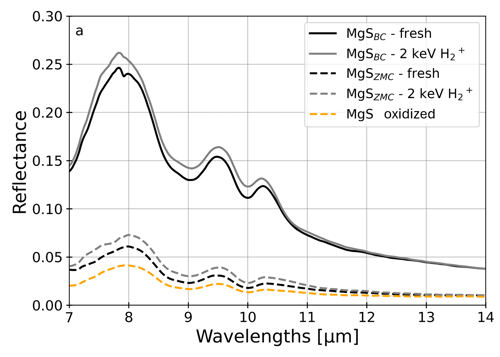
Subsequent spectral analysis of the irradiated CaS and MgS showed brightening in parts of the visible range (0.4-0.7 µm) of the VNIR (Fig. 1) and an overall brightening in the mid-infrared (MIR) range observed by BepiColombo (7-14 µm, Fig. 2). The sample labeled as oxidized was exposed to air for months after the experiments, which led to an overall darkening in both VNIR and MIR, erasing the effect of irradiation. On Mercury, there is no immediate oxidation of the top layer; instead, re-deposition of thermal and ion desorbed material introduces surface contaminants, which over geological timespans could form a layer. The radiation-hard nature of sulfides could thereby act as a cleaning mechanism, where contaminants are removed continuously under solar wind exposure without damaging the bulk, preserving the reflectivity of the sample. This process provides a new framework for understanding the formation of bright hollow materials, highlighting the importance of non-transition-metal sulfides in Mercury’s surface evolution.


Figure 1: Visual-to-near infrared measurement of fresh MgS (black line) compared to 2 keV protons (salmon) and an old, oxidized sample (yellow). Two unirradiated MgS samples are shown, whereas one is fresh (syn) and one is old and oxidized (old).


Figure 2: Mid-infrared measurements of two MgS samples sourced from BenchChem (BC, solid lines) and Zegen Metals & Chemicals (ZMC, dashed lines). The irradiated samples (light gray) have a consistently higher reflectivity than the unirradiated (fresh) samples. The heavily oxidized sample (yellow) is the darkest.


How to cite: Jäggi, N., Barraud, O., and Dukes, C.: Self-cleaning Sulfides as Mercury Hollow Bright Material, EGU General Assembly 2026, Vienna, Austria, 3–8 May 2026, EGU26-5210, https://doi.org/10.5194/egusphere-egu26-5210, 2026.

X4.111
|
EGU26-21371
Gaetano Di Achille, Piero D'Incecco, and Yelena Caddeo

The knowledge of Mercury's crater record has significantly evolved during the last decade thanks to the MESSENGER mission, which enabled the implementation of updated global crater catalogs by allowing the identification of a wealth of previously unknown impact structures. Particularly, recent re-examination of MESSENGER data led to the identification of tens of previously unreported large (D>150 km) impact basins. These large basins have not yet been studied in detail despite their significant geological and geophysical importance. Here, we present geological, topographical, structural, compositional, and geophysical investigations of one (maybe the largest) of these basins. The basin has not yet an International Astronomical Union (IAU) name but it has been reported as b56 or Lennon-Picasso basin in the published literature. The basin has an approximate diameter of more than 1500 kilometers and is centered at about 15S, 50E, located north-westward of Rembrandt basin. However, the most external structures associated to this basin extend fairly more than 1500-km form its center, suggesting a diameter closer if not higher than 2000 km, thus equivalent if not bigger than Caloris basin, known as the largest Mercury’s basin. Geology, tectonics, and composition of this basin have been investigated by using photointerpretation and remote sensing techniques applied to all the available data. Visible imagery from MDIS camera has been integrated with Digital Elevation Models (DEM), spectral data (color mosaics and data from MASCS), and gravity data from the Radio Science (RS) experiment onboard of MESSENGER into Geographic Information System (GIS) environment. DEM and slope maps highlight the annular terraced floor of the basin, suggesting that this may have formed as a peak ring or multiring structure. The basin is defined by several major lineaments (up to thousands of km long) consisting of a series of tectonic structures encompassing a broadly circular topographic low corresponding to the internal floor of the basin. This central region shows a gravity anomaly and a low crustal thickness with respect to the surrounding areas. The impact triggered volcanic activity since the floor presents the typical characteristics of other volcanic infilled Mercury’s basins: a smoother texture and lower albedo with respect to the surroundings regions, radial faults, wrinkle ridges and concentric circular lobate scarps, and spectral signatures from MASCS data. Most importantly, our results show that the tectonics associated to this basin, along as that of many other recently discovered large basins, might have had a regional and global significance, which has been so far overlooked. Indeed, these impact-related structures have been so far included in current estimates of Mercury’s contraction, most likely leading to its overestimation. After presenting the above mentioned lines of evidence we will discuss the implications of the tectonics of Mercury’s large basins for the planet global tectonics and contraction estimates.

How to cite: Di Achille, G., D'Incecco, P., and Caddeo, Y.: Don’t call it b56: geology and geophysics of a Caloris-size impact basin and implications for Mercury’s global tectonics, EGU General Assembly 2026, Vienna, Austria, 3–8 May 2026, EGU26-21371, 2026.

X4.112
|
EGU26-20040
|
ECS
Akin Domac, Solmaz Adeli, Joern Helbert, Christian Althaus, Alessandro Maturilli, Mario D'Amore, Oceane Barraud, Stephen Garland, Joerg Knollenberg, Ingo Walter, Nimisha Verma, Aurelie Van der Neucker, Giulia Alemanno, Andreas Lorek, Christopher Hamann, Kai Wünnemann, and Harald Hiesinger

The MERTIS (Mercury Radiometer and Thermal Infrared Spectrometer) instrument aboard the ESA–JAXA BepiColombo mission is designed to characterize Mercury’s surface mineralogy using thermal infrared spectroscopy in the 7-14 µm range [1,2]. During BepiColombo’s fifth Mercury flyby on 1 December 2024, MERTIS acquired the first spatially resolved mid-infrared spectra of Mercury’s surface, collecting more than 1.4 million spectra at spatial resolutions of approximately 26–30 km per pixel [3,4]. These observations revealed spectral variations associated with impact craters, bright and dark deposits, and other geological features, providing an important preview of the global dataset that will be obtained after Mercury orbit insertion in late 2026.

However, interpreting thermal infrared spectra of Mercury is challenging due to the planet’s extreme surface temperatures (~100–700 K) and strong thermal gradients, which produce non-isothermal conditions within individual MERTIS pixels. These conditions obscure mineralogical features by blending them with multiple temperature-dependent Planck radiation, making accurate determination of the emissivity a central challenge [1,5,6]. In addition, thermal infrared spectral features are influenced by physical surface properties such as grain size, porosity and surface roughness, further increasing interpretation uncertainties [7,8,9]. Robust analysis of the upcoming global MERTIS dataset therefore requires laboratory reference measurements under comparable conditions.

To support ongoing laboratory studies, we developed the MERTIS Imaging Model for Instrument Characterization (MIMIC), a dedicated laboratory emulator that reproduces the imaging geometry and spectral behavior of MERTIS. MIMIC is designed as a complementary approach to established bulk emissivity measurements acquired with Fourier-transform infrared (FTIR) spectroscopy, extending these methods by enabling spatially resolved thermal infrared imaging under Mercury-like thermal conditions at DLR’s Planetary Spectroscopy Laboratory (PSL). Through a mid-infrared transparent window mounted on a high-temperature, evacuated emissivity chamber, MIMIC produces imaging data that are comparable to MERTIS observations. This capability allows systematic investigation of how surface physical properties, such as grain size, grain shape (angularity and sphericity), porosity, and surface roughness, affect thermal emission at the pixel scale. By bridging laboratory spectroscopy with orbital observations, MIMIC offers a unique platform to improve the interpretation of MERTIS data and our understanding of mid-IR emission processes on airless planetary bodies.

[1] Hiesinger, H., et al., 2010, Planetary and Space Science [2] Helbert, J., et al., 2013, SPIE [3] Hiesinger, H., et al., 2025, LPSC [4] Adeli, S., et al., 2025, EPSC-DPS [5] Wohlfarth, K., et al., 2023, Astronomy & Astrophysics [6] Tenthoff, M., et al., 2025, EPSC-DPS [7] Maturilli, A., et al., 2006, Planetary and Space Science [8] Morlok, A., et al., 2016, Icarus [9] Martin, A.C., et al., 2025, JGR Planets

How to cite: Domac, A., Adeli, S., Helbert, J., Althaus, C., Maturilli, A., D'Amore, M., Barraud, O., Garland, S., Knollenberg, J., Walter, I., Verma, N., Van der Neucker, A., Alemanno, G., Lorek, A., Hamann, C., Wünnemann, K., and Hiesinger, H.: A Laboratory Imaging Emulator for the MERTIS Instrument in preparation for BepiColombo Mission: MIMIC, EGU General Assembly 2026, Vienna, Austria, 3–8 May 2026, EGU26-20040, 2026.

X4.113
|
EGU26-16269
Go Murakami, Geraint Jones, and Sébastien Besse

The ESA-JAXA joint mission BepiColombo is still on the track to Mercury and will be inserted into Mercury orbit in November 2026. It completed all flybys by January 2025 and conducted numerous scientific observations. The Mercury Transfer Module will be first separated in September 2026, followed by insertion into Mercury's orbit in November 2026. Subsequently, the Mercury Magnetospheric Orbiter (Mio) will separate in December 2026, deploying its wire antennas and magnetometer masts. Following initial checkout of the spacecraft bus and scientific instruments, along with test observations, the nominal science phase will start in April 2027. The baseline observation plans for Mio faces thermal constraints during the perihelion season and power constraints during the aphelion season, respectively. Operation planning and updating is progressing to address these limitations. This presentation will report on the latest status of BepiColombo/Mio and its upcoming operation and observation plans.

How to cite: Murakami, G., Jones, G., and Besse, S.: Updates and upcoming operation plans of BepiColombo/Mio, EGU General Assembly 2026, Vienna, Austria, 3–8 May 2026, EGU26-16269, 2026.

X4.114
|
EGU26-18943
Helmut Lammer, Fabian Weichbold, Manuel Scherf, Daniel Schmid, Alexey Berezhnoy, Ali Varsani, and Martin Volwerk

Because of Mercury’s close orbital position to the Sun and its low mass, the planet cannot retain a dense atmosphere and instead possesses an exosphere. The gaseous species detected so far - such as H, (Mariner 10, MESSENGER), He (Mariner 10, MESSENGER, BepiColombo flyby), (possibly) O (Mariner 10), Na, K, Ca (ground-based and MESSENGER), Mg (MESSENGER), and Li and H2 (inferred from MESSENGER magnetic field data) - yield a column content in the order of about 1012 cm−2, which is lower than the expected column content of an exosphere which is in the order of about 1014 cm−2. In addition to these elements, MESSENGER’s FIPS instrument also detected C, OH, H2O, Ne, Al, Si, O2, Ar, CO2, Ti, and Fe ions at the downstream of Mercury. Atmospheric measurements from the Mariner 10 occultation experiment indicate that the electron density near the planet's surface is less than 103 cm-3 on both sides of the planet, implying an upper limit to the dayside surface gas number density of about 106 cm-3. The observed elements are expected to represent only a small fraction of Mercury’s exosphere,  as the total surface pressure contributed by these known species is far lower than the upper limit for the exospheric surface pressure of 10-11 - 10-12 bar. While H and He appear to originate from the solar wind (i.e., thermal release of implanted solar wind ions), heavier elements are sourced from the planet’s regolith and may be delivered by meteoroids of various sizes. In this study, we investigate the role of meteoroids and their contribution to the elemental input on Mercury's surface and exosphere. We also discuss the potential effects of meteoritic material on the volatile components of the planet's surface composition and examine which currently undetected elements, potentially delivered from meteoroids, may contribute to the still-unknown surface pressure.

How to cite: Lammer, H., Weichbold, F., Scherf, M., Schmid, D., Berezhnoy, A., Varsani, A., and Volwerk, M.: The role of meteoritic delivery to Mercury’s surface-exosphere environment, EGU General Assembly 2026, Vienna, Austria, 3–8 May 2026, EGU26-18943, 2026.

X4.115
|
EGU26-14265
Valeria Mangano, Francois Leblanc, Dario Del Moro, Anna Milillo, Martina Moroni, Bernard Gelly, Richard Douet, Didier Laforge, and Joe Zender

Mercury’s exosphere has been extensively investigated through ground-based observations. Since 2007, the THEMIS solar telescope was used to conduct a long-term monitoring campaign of the sodium (Na) exosphere, enabling detailed studies of its morphology and variability at different timescales driven by interactions between Mercury’s surface, intrinsic magnetic field, neutral and ionized environment, and the solar wind and radiation. They allowed to investigate the contribution of the different source processes as well as the statistical frequency of the different morphological patterns, and the rapid change from one to another at the sudden change of interplanetary magnetic field conditions.

In 2022, 2023, and 2024, we carried out targeted observations of Mercury’s sodium exosphere in the days surrounding three of the six flybys performed by the ESA–JAXA BepiColombo spacecraft around the planet. The objective was to provide a global view of the exospheric morphology and dynamics during the spacecraft’s close-approach phase, when also several in-situ instruments were simultaneously operating. These measurements offered crucial information on the planetary environment, including magnetic fields, as well as ion, electron, and neutral populations across a wide range of energies, and radiation.

We present and compare the three exospheric configurations observed in the days around these three flybys, highlighting their morphological and dynamical similarities and differences.

How to cite: Mangano, V., Leblanc, F., Del Moro, D., Milillo, A., Moroni, M., Gelly, B., Douet, R., Laforge, D., and Zender, J.: The Exosphere of Mercury during BepiColombo's Flybys 2, 3, and 4, EGU General Assembly 2026, Vienna, Austria, 3–8 May 2026, EGU26-14265, 2026.

X4.116
|
EGU26-7327
|
ECS
Liam Edwards, Manuel Grande, David Lawrence, Rami Vainio, Sae Aizawa, Lina Hadid, Jim Raines, Arto Lehtolainen, Eero Esko, and Emilia Kilpua

Mercury hosts a small global magnetic field, approximately 1% of Earth’s magnetic field strength, capable of standing off the solar wind, resulting in a magnetosphere that is qualitatively similar in structure to Earth’s. However, due to its closer proximity to the Sun, Mercury’s magnetosphere experiences much stronger solar wind pressure than that at Earth, resulting in dynamic magnetospheric processes that occur on much shorter timescales. These extreme conditions can result in processes such as particle energization, transport and precipitation onto the planetary surface, which are strongly influenced by the external solar wind conditions. Here, we present observations of energetic protons (> ~ 1 MeV) and electrons (> ~ 70 keV) from the Solar Intensity X-Ray and Particle Spectrometer (SIXS) onboard the BepiColombo spacecraft during its sixth and final Mercury flyby on 8 January 2025. Similar to the spacecraft’s fourth Mercury flyby in 2024, a solar energetic particle event occurred a few days before closest approach, resulting in elevated fluxes of energetic particles both outside and within the Hermean magnetosphere. Furthermore, the KTH22 Mercury magnetic field model was used to help interpret these energetic particle observations and to evaluate whether features in the data were consistent with the aforementioned magnetospheric processes.

How to cite: Edwards, L., Grande, M., Lawrence, D., Vainio, R., Aizawa, S., Hadid, L., Raines, J., Lehtolainen, A., Esko, E., and Kilpua, E.: Energetic Particle Observations with SIXS During BepiColombo’s Sixth Mercury Flyby, EGU General Assembly 2026, Vienna, Austria, 3–8 May 2026, EGU26-7327, https://doi.org/10.5194/egusphere-egu26-7327, 2026.

X4.117
|
EGU26-19073
Riku Jarvinen, Ilja Honkonen, Esa Kallio, David Phillips, Stepan Dubyagin, Samuel Grant, and Mikko Borg

We present global modelling of Mercury’s solar wind interaction with the open-source 3D hybrid-particle code framework RHybrid (paRallel Hybrid) in light of BepiColombo's flybys and forthcoming orbital science observations. In the hybrid-particle model, ions are treated kinetically as macroscopic particle clouds (macroparticles) moving under the Lorentz force, while electrons are described implicitly as a charge-neutralising, inertialess fluid governed by Ohm’s law. The kinetic ion dynamics are coupled to the evolution of the magnetic field through Faraday’s law, and the system is closed using Ampère’s law. This approach allows ion velocity distributions to evolve self-consistently, capturing wave-particle interactions, finite Larmor radius effects, and other ion-kinetic processes. The code is highly parallelised using message passing between compute nodes, enabling efficient use of large high-performance computing resources. This allows us to simulate spatial structures and ion velocity distributions in the Hermean plasma environment with high resolution, resolving the coupling between ion scales and global magnetospheric scales.

In the model, Mercury’s surface is represented as a particle-absorbing boundary, with the underlying crust–mantle region modelled as a resistive spherical shell overlying an ideally conducting core. The intrinsic planetary magnetic field is prescribed as a dipole offset northward from the planet’s centre, or alternatively by any other 3D planetary magnetic field model. The production of exospheric ion species is described through photoionisation of arbitrary 3D neutral density profiles.

Here we discuss the application of global hybrid modelling to study the formation, structure, and dynamics of different regions in the Hermean plasma environment, as well as ongoing development of the RHybrid code, including adaptive mesh refinement, temporal substepping, and improved electron physics. Mercury’s environment is characterised by strong couplings and feedbacks between the solar wind, magnetosphere, exosphere, surface, mantle, and core. Global hybrid modelling provides essential context for interpreting in situ observations, enables controlled numerical experiments under varying conditions, and supports systematic and flexible investigations of the scaling of solar wind interaction processes.

How to cite: Jarvinen, R., Honkonen, I., Kallio, E., Phillips, D., Dubyagin, S., Grant, S., and Borg, M.: Interpreting BepiColombo's observations of Mercury's solar wind interaction with global hybrid-particle simulations, EGU General Assembly 2026, Vienna, Austria, 3–8 May 2026, EGU26-19073, 2026.

X4.118
|
EGU26-11061
Willi Exner and Norberto Romanelli

Planetary magnetospheres are elaborate systems of internal and external factors, ranging from the internal planetary magnetic moment and currents in the magnetospheric boundaries to exosper-ionosphere-surface interaction, and variation in solar wind properties.
In general, these flows and fields are usually interacting non-linearly.
However, there are regions in the magnetosphere where properties may be understood in terms of a linear superposition.
Here, we investigate the far downtail regions of the nightside magnetotail, where two key factors are the compressed but decreasing planetary magnetic field and the surrounding interplanetary magnetic field (IMF).

Thus, we conduct 12 global model runs of Mercury's magnetosphere with 6 IMF directions in Cardinal and Parker Spiral directions each.
We then superimpose 3 Cardinal IMF runs to emulate linear combined Parker Spiral (LC) IMF cases and compare these to the real Parker Spiral IMF case runs along the downtail passages of the MPO and Mio spacecraft of the BepiColombo mission.
It is found that most LC cases share a surprising level of similarity with the real IMF cases for features such as the general tail twist, suggesting that some physical processes within the magnetotail may be described as linear, despite the overall interaction is non-linear.
Finally, we further investigate approaches to the definition of a threshold of linearity.

How to cite: Exner, W. and Romanelli, N.: On the Linearity of Mercury's Nightside Magnetosphere, EGU General Assembly 2026, Vienna, Austria, 3–8 May 2026, EGU26-11061, https://doi.org/10.5194/egusphere-egu26-11061, 2026.

X4.119
|
EGU26-17940
|
ECS
Inès Mertz, Léa Griton, Filippo Pantellini, Ahmed Houeibib, Karine Issautier, Baptiste Verkampt, and Kirolosse Girgis

Most global simulations of Mercury’s magnetosphere assume a steady solar wind. However, the planet's extremely small magnetosphere responds on characteristic timescales of only a few minutes, making it inherently sensitive to solar-wind variability. Such rapid temporal forcing is expected to generate a highly dynamic magnetospheric environment, favorable to the development of plasma instabilities. These processes can facilitate electron entry into the magnetosphere, their subsequent trapping and acceleration and, in some cases, their direct interaction with Mercury’s exosphere and surface.

To investigate these effects, we perform global magnetohydrodynamic (MHD) simulations of Mercury’s magnetospheric response to both steady and time-dependent solar-wind conditions using the spherical code PLANET_MAG_AMRVAC. These simulations are designed to support the upcoming science phase of the BepiColombo mission, scheduled to begin in less than a year, by predicting magnetospheric and exospheric observables accessible to instruments onboard both Mio and MPO under a broad range of solar-wind conditions.

As a first step, the model was tested through comparisons with electron density measurements obtained by the MEA1 instrument onboard Mio during Mercury’s three firsts flybys. The simulations include a planetary plasma source driven by the photoionization of exospheric neutrals, allowing for a more realistic representation of plasma populations in Mercury’s near-planet environment. In parallel, the code was used to predict the quasi-thermal noise spectra measurable by the SORBET instrument during flybys, when the antennas cannot be fully deployed during the cruise phase.

Building on this foundation, the focus of this work is the impact of transient solar wind structures -- for now magnetic holes or vortices -- on Mercury’s magnetosphere. Particular attention is paid to their transmission through the bow shock, their evolution within the magnetosheath, and the conditions under which they can penetrate into the magnetosphere.

To address these questions, we first adopt a global MHD approach to capture the large-scale dynamics and overall morphology of these events. We then aim to confront these results with kinetic or particle-in-cell (PIC) simulations in order to explore the associated small-scale physics beyond the MHD framework. Finally, we outline ongoing and future work involving the injection of test particles, treated within the guiding-center approximation, in selected regions of interest. This approach will allow us to investigate particle transport, acceleration, and loss processes in Mercury’s magnetosphere under different solar-wind disturbance scenarios.

How to cite: Mertz, I., Griton, L., Pantellini, F., Houeibib, A., Issautier, K., Verkampt, B., and Girgis, K.: The dynamic response of Mercury’s magnetosphere to solarwind forcing: consequences for the acceleration of chargedparticles in a telluric planetary environment, EGU General Assembly 2026, Vienna, Austria, 3–8 May 2026, EGU26-17940, 2026.

X4.120
|
EGU26-19710
Daniel Heyner, Kristin Pump, Patrick Kolhey, Ferdinand Plaschke, Anne Pommier, and Catherine Johnson

Mercury hosts a highly dynamic magnetosphere in which energy and momentum can be transported between different regions by field-aligned currents (FACs). The region 1 FAC are generated near the dawnside magnetopause, propagate along magnetic field lines toward the planet, and return toward the dusk magnetospheric flank. In-situ observations have established FACs as a ubiquitous feature of the Hermean magnetosphere. However, in the absence of a substantial ionosphere, the mechanisms by which these currents close remain poorly understood. In this study, we present the analysis results from in-situ MESSENGER magnetic field observations and apply the magnetometric resistivity inversion technique to infer FAC closure pathways above and within the planetary surface and within Mercury’s interior without any pre-assumptions about the conductivity structure. We further show the influence of different inversion side constraints, including solenoidal current continuity and minimum-norm regularization, on the inferred current systems.

How to cite: Heyner, D., Pump, K., Kolhey, P., Plaschke, F., Pommier, A., and Johnson, C.: Magnetometric Resistivity Inversion of Region 1 Field-Aligned Currents in Mercury’s Interior, EGU General Assembly 2026, Vienna, Austria, 3–8 May 2026, EGU26-19710, 2026.

X4.121
|
EGU26-5030
Martin Volwerk, Tomas Karlsson, Charlotte Goetz, Daniel Heyner, Ferdinand Plaschke, Daniel Schmid, Cyril Simon Wedlund, Rumi Nakamura, Francesco Califano, Maria Hamrin, Francesco Pucci, Adriana Settino, and Diana Rojas-Castillo

The MESSENGER magnetometer data for the years 2012 through 2015 are used to study the presence of mirror modes in Mercury's environment. Using magnetic field only detection of these structures, 10715 intervals of 20 s and longer are found in the solar wind, and in the magnetosheath and magnetosphere of Mercury. The distribution of mirror modes around the planet is similar to that found at Venus and Mars, however, the occurrence rate of 1.0E-4 per second is up to 2 orders of magnitude smaller than at the other two planets. The mirror modes are more prone to be excited near Mercury's aphelion. A comparison shows that mirror modes and magnetic holes have a similar behaviour around Mercury, and that about 40% of the mirror modes can also be identified as magnetic holes. Ion cyclotron waves show a lesser dependence on the true anomaly angle.

How to cite: Volwerk, M., Karlsson, T., Goetz, C., Heyner, D., Plaschke, F., Schmid, D., Simon Wedlund, C., Nakamura, R., Califano, F., Hamrin, M., Pucci, F., Settino, A., and Rojas-Castillo, D.: Mercury's Mirror Modes?, EGU General Assembly 2026, Vienna, Austria, 3–8 May 2026, EGU26-5030, https://doi.org/10.5194/egusphere-egu26-5030, 2026.

Please check your login data.