VPS6 | BG virtual posters II
BG virtual posters II
Co-organized by BG
Convener: Ana Bastos
Posters virtual
| Wed, 06 May, 16:15–18:00 (CEST)
 
vPoster Discussion, Thu, 07 May, 14:00–15:45 (CEST)
 
vPoster spot 2
Wed, 16:15

Posters virtual: Wed, 6 May, 14:00–18:00 | vPoster spot 2

The posters scheduled for virtual presentation are given in a hybrid format for on-site presentation, followed by virtual discussions on Zoom. Attendees are asked to meet the authors during the scheduled presentation & discussion time for live video chats; onsite attendees are invited to visit the virtual poster sessions at the vPoster spots (equal to PICO spots). If authors uploaded their presentation files, these files are also linked from the abstracts below. The button to access the Zoom meeting appears just before the time block starts.
Discussion time: Wed, 6 May, 16:15–18:00
Display time: Wed, 6 May, 14:00–18:00
14:00–14:03
|
EGU26-14857
|
Origin: BG1.1
|
ECS
Salvatore Curasi, Joe Melton, Elyn Humphreys, Vivek Arora, Jason Beaver, Alex Cannon, Jing Chen, Txomin Hermosilla, Sung-Ching Lee, and Michael Wulder

Canada’s terrestrial ecosystems play a critical role in the global carbon cycle and are being affected by unprecedented climate change and wildfire disturbance. However, we have an incomplete understanding of Canada’s historical carbon cycle. Existing assessments, conducted at varying spatial scales, use a wide range of data sources and methodologies, which lead to significant differences in the estimated strength of Canada’s land carbon sink over recent decades. Moreover, many approaches (e.g., inversions and data-driven estimates) have a limited ability to disentangle the relative contributions of different processes to the carbon sink over the recent past (1700 - 2022). We addressed this gap using a land surface model recently tailored to Canada and the most comprehensive information depicting wildfire disturbance and timber harvest available to make, to our knowledge, the first physically coherent wall-to-wall estimates of all major carbon pools and fluxes for Canada. We show that Canada’s terrestrial ecosystems have been a carbon sink since the mid-20th-century, due to the influence of wildfire and timber harvest before 1940. Since the early 2000s, wildfire disturbance has been driving Canadian forests towards becoming a carbon source. Based on our findings from a purely process-oriented perspective, projected increases in wildfire activity will further impact the strength and direction of Canada's terrestrial carbon sink.

How to cite: Curasi, S., Melton, J., Humphreys, E., Arora, V., Beaver, J., Cannon, A., Chen, J., Hermosilla, T., Lee, S.-C., and Wulder, M.: Canada’s forests shifting from a recovery-driven carbon sink to a disturbance-driven carbon source, EGU General Assembly 2026, Vienna, Austria, 3–8 May 2026, EGU26-14857, https://doi.org/10.5194/egusphere-egu26-14857, 2026.

14:03–14:06
|
EGU26-12529
|
Origin: BG3.5
|
ECS
Yuzuo Zhu, Thomas A. M. Pugh, and Minchao Wu

Plant responses to dry environments are shaped by diverse adaptive strategies linked to plant hydraulic traits, as reflected by the coexistence of deciduous and evergreen tree species in tropical seasonally dry forests. Empirical evidence suggests that leaf shedding is associated with declining leaf water potential, while leaf flushing depends on xylem rehydration. However, these physiological mechanisms are rarely incorporated into Dynamic Global Vegetation Models (DGVMs), which typically represent drought deciduous phenology using highly-simplified, threshold-based schemes with fixed rates of leaf phenological change. Here, we develop a stress–gradient based phenology scheme in which leaf shedding and leaf flushing are driven by the temporal gradients of leaf water potential and xylem water potential, respectively. This gradient–driven phenology mechanism was implemented in the LPJ-GUESS DGVM and validated with in-situ observations of phenological responses along hydraulic gradients. The new model has successfully reproduced phenological dynamics for the 7 selected locations and substantially improves model performance in simulating plant transpiration. We provide evidence that plant hydraulics are key controls for the phenological dynamics of tropical dry forests. The proposed stress-gradient phenological mechanism, linking phenology to plant hydraulic status, is an efficient approach to represent landscape phenology and improve simulations of water and carbon cycling over the tropical drylands. It may also help improve our understanding of forest response to drought stress, which remains largely unknown under warming climates.

How to cite: Zhu, Y., Pugh, T. A. M., and Wu, M.: Modelling Tropical Dry Forest Phenology from a Plant Hydraulic Perspective, EGU General Assembly 2026, Vienna, Austria, 3–8 May 2026, EGU26-12529, https://doi.org/10.5194/egusphere-egu26-12529, 2026.

14:06–14:09
|
EGU26-16813
|
Origin: BG3.41
|
ECS
Plant heat tolerance across a heteregenous alpine landscape: From distribution to microclimate
(withdrawn)
Lisa Danzey, Andy Leigh, Adrienne Nicotra, and Susanna Venn
14:09–14:12
|
EGU26-5322
|
Origin: BG4.1
|
ECS
Yolanda Espín Montoro, Gustavo Martínez Couque, José Antonio Fernández Pérez, Manuel Álvarez Ortí, and Juan José Gómez Alday

The attenuation of atrazine in the saline water of the hypersaline Pétrola lake from a natural reserve (SE Spain) was studied to get more insight into the processes governing the fate of the contaminant in highly saline environments. In microcosms, the water column was spiked with 15.4 mg/L of atrazine for 24 days. Before atrazine amendment, the initial distribution of bacterial community was mostly composed of Proteobacteria (25.5 %), Cyanobacteria (25.2 %), Actinobacteriota (18.5 %), Verrucomicrobiota (11.5 %) and Bacteroidota (10.1 %). Within the mayor phyla, the most abundant families were identified as Cyanobiaceae (25 %), Rhodobacteraceae (10 %), Alcaligenaceae (9.9 %), Microbacteriaceae (7.3 %) and a poorly described PeM15 (6.2 %).

The reduction of atrazine concentration in the water column reaches 86.9 %, which means a reduction of dissolved atrazine mass of 98.1 %. Parallel to the decrease in atrazine, the amount of its intermediate degradation metabolite, desethylatrazine, increased. Desethylatrazine was the major short-term metabolite within the first 8-12 days, indicating the potential activity by atrazine-degrading bacteria. No deisopropylatrazine was detected in the saline water above detection limit. Microbiology results showed that atrazine can be removed from the saline lake environment. After atrazine amendment, the taxonomic bacterial composition at phylum level shifted to Proteobacteria (60.8 %), Patescibacteria (9.7 %), Bacteroidota (7.3 %), Campylobacterota (6.4 %) and Actinobacteriota (2.1 %). Atrazine supplementation suggested a selective pressure on bacterial structure morphology through the emergence of different dominant groups (i.e., Campylobacterota) or even the eradication of those phyla of bacteria capable of photosynthesis (i.e., Cyanobacteria). At family level, Rhodobacteraceae (16.7 %), Burkholderiaceae (11.7 %), Thiomicrospiraceae (7.9 %), Methylophagaceae (6.7 %), Sulfurimonadaceae (4.4 %) and Solimonadaceae (3.3 %) were the most abundant in the water column at the end of the experiment.

Related atrazine-degrading families established at the end of the experiment were Rhodobacteraceae, Solimonadaceae, Pseudomonadaceae, Rhizobiaceae, Chromatiaceae, Bacillaceae, Xanthomonadaceae, Caulobacteraceae, Moraxellaceae, Streptomycetaceae, Microbacteriaceae and Nannocystaceae. Related candidates such as Pseudomonas paralactis, Microbacterium sp., or Arthrobacter sp., among others, were isolated in water samples from previous studies. The bacterial candidates for atrazine degradation identified in the water column indicate that the herbicide acted as a selective pressure factor, altering the composition of the bacterial pattern. The water column would constitute a reactive environment which may govern the fate of pesticides in saline surface water bodies.

How to cite: Espín Montoro, Y., Martínez Couque, G., Fernández Pérez, J. A., Álvarez Ortí, M., and Gómez Alday, J. J.: Selective pressure of atrazine on bacterial pattern in a hypersaline lake environment , EGU General Assembly 2026, Vienna, Austria, 3–8 May 2026, EGU26-5322, https://doi.org/10.5194/egusphere-egu26-5322, 2026.

14:12–14:15
|
EGU26-4468
|
Origin: BG4.5
Malcolm Hart and Jodie Fisher

The EU Nature Restoration Regulation is the first continent-wide, comprehensive law of its kind and is a key component of the EU Biodiversity Strategy. This sets binding targets to restore degraded ecosystems, particularly those with the most potential to capture and store carbon and to prevent, and reduce, the impact of natural disasters. The EU Nature Restoration Regulation contains seven specific targets, including:

‘marine ecosystems – restoring marine habitats such as seagrass beds or sediment bottoms that deliver significant benefits, including for climate change mitigation…….’

The 800 hectares of seagrass meadows in South-West England are rightly regarded as important biodiversity ‘hot spots’, providing habitats for many species of juvenile fish, cuttlefish and sea horses. Many of the meadows in the region have been impacted by a ‘Seagrass Wasting Disease’ in the 1930s and the more recent damage caused by the anchoring of small boats (usually pleasure craft). This damage is being rectified by re-planting of seagrass, but many of those engaged in this work do not appreciate the full story behind the present distribution and development of the meadows.

The oldest seagrasses are known from the Maastrichtian of The Netherlands and are found in the Maastricht Chalk Formation (70 million years’ old). Between that time and the present day there are very few direct records of seagrass fossils, and this is because:

  • Seagrass meadows from the tidal/inter-tidal boundary are not in an environment that is commonly preserved in the geological record; and
  • In modern seagrass meadows, the plants are rarely – if ever – preserved and are rarely found in cores drilled into the meadows below ~30 cm.

In marine cores taken in Plymouth Sound and elsewhere in Southern England there are only low levels of carbon (spores, pollen, dinoflagellates, seeds, and organic debris) and not the high levels that would be required to suggest that sea grasses sequester high levels of ‘blue carbon’ for extended periods of time. The accumulation of low carbon levels can be explained by the enhanced sedimentation created by the seagrass, the so-called allochthonous carbon. The one element of carbon sequestration that is often ignored is that of foraminifera, ostracods and bryozoans, all of which are extremely abundant in meadow sediments. In many cases, the biodiversity of the foraminifera (>100 species) dwarfs the usual biodiversity counts of larger organisms. Such fixed calcium carbonate does have a long-term storage potential.

The other issue that can be ignored by those studying seagrasses is that the marine environment has undergone significant change throughout the 1 million years of the Pleistocene/Holocene and many of the seagrass meadows have only just re-established themselves following the Last Glacial Maximum, when sea levels were 120‒130 m below present-day levels. How seagrass migrated back into the present-day coastal areas is not yet fully understood, including the separation of the inter-tidal and sub-tidal taxa.

How to cite: Hart, M. and Fisher, J.: South-West England seagrasses: ecology, evolution and contribution to biodiversity and carbon sequestration , EGU General Assembly 2026, Vienna, Austria, 3–8 May 2026, EGU26-4468, https://doi.org/10.5194/egusphere-egu26-4468, 2026.

14:15–14:18
|
EGU26-6116
|
Origin: BG4.5
|
ECS
Sarah G. Parker, Beau Tryzbiak, Arya Patel, Gabriel Pereira, Lisa Chambers, and Melanie Beazley

Microorganisms in estuarine and coastal ecosystems are subject to changes in salinity and nutrient loads as well as threats from emerging contaminants, sea level rise, extreme weather patterns, and human encroachment. These ecosystems are of economic and ecological importance due to their biological diversity as well as their role in carbon sequestration, flood protection, and erosion prevention. However, the microbial community structure in the sediment of estuarine systems remains under researched despite the abundant ecosystem services they provide. In this study, we surveyed 25 sites within Econfina River State Park located in the eastern portion of the Northern Gulf of Mexico along a salinity gradient from freshwater upstream to coastal seagrass beds downstream. DNA extracted from the top 10 cm of sediment were 16S rRNA amplicon sequenced to determine microbial community structure. Results contribute to the understanding of microbial ecology of coastal ecosystems in the Northern Gulf of Mexico.

How to cite: Parker, S. G., Tryzbiak, B., Patel, A., Pereira, G., Chambers, L., and Beazley, M.: Spatial Variation in Sediment Bacterial Communities Along a Salinity Gradient in a Northern Gulf of Mexico Coastal Ecosystem, EGU General Assembly 2026, Vienna, Austria, 3–8 May 2026, EGU26-6116, https://doi.org/10.5194/egusphere-egu26-6116, 2026.

14:18–14:21
|
EGU26-15259
|
Origin: BG4.5
|
ECS
Nipuni Perera, Melissa Wartman, Siegmund Nuyt, Peter Macreadie, and Micheli Duarte de Paula Costa

Sea level rise (SLR) is a key driver in altering spatial boundaries, species distribution, and functioning of coastal wetlands in the 21st century. Wetland adaptation to SLR depends on vertical accretion and landward migration; however, the magnitude and rate of these processes remain uncertain and are constrained by factors such as sediment supply and the availability of inland accommodation space. To enhance adaptive capacity, spatially explicit assessments are critical for identifying areas suitable for wetland migration. Nevertheless, much of the existing literature emphasises global-scale analyses with coarse spatial resolution and limited use of local SLR projections, which reduces their applicability for regional and local decision-making.

We conducted a scenario-based assessment of the potential extent of landward migration for mangroves and saltmarshes in Victoria, Australia, using high-resolution (10 m) regional spatial data under two socio-economic pathways (SSP2 and SSP5) for 2070 and 2090. The results indicate that, for both ecosystems, potential area gains from landward migration exceed losses from seaward inundation. For saltmarshes, ecosystem losses are driven more by mangrove encroachment (53%) than by inundation (47%). Land tenure emerges as a key factor shaping wetland migration capacity. Future accommodation space for mangroves is largely under public ownership (56%), primarily within protected areas and nature reserves (56.2%), providing a relatively secure buffer for inland migration. In contrast, most accommodation space for saltmarshes is privately owned (56.4%) and predominantly associated with primary production land use (45.4%). Without specific management actions, saltmarshes are likely to experience losses from both expanding mangroves and ongoing land-use pressures. Overall, these findings provide valuable insights to support stakeholders in scenario-based planning and the management of coastal and urban areas to enable wetland adaptation to rising sea levels.

How to cite: Perera, N., Wartman, M., Nuyt, S., Macreadie, P., and Duarte de Paula Costa, M.: Landward Migration of Coastal Wetlands under Land-Use Constraints in Australia, EGU General Assembly 2026, Vienna, Austria, 3–8 May 2026, EGU26-15259, https://doi.org/10.5194/egusphere-egu26-15259, 2026.

14:21–14:24
|
EGU26-984
|
Origin: BG4.5
|
ECS
Dzaki Satrio Widanto, Sigit Deni Sasmito, and Nathan Waltham

Seagrass ecosystems in Indonesia provide a diverse array of services and societal benefits that helps to mitigate the impacts of climate change, yet they face complex threats and ongoing declines. Assessing their diverse values through pluralistic lenses can provide important baseline information to guide future conservation and restoration policies. Utilising the Seagrass Ecosystem Contributions to People (SCP) framework, a systematic review was conducted in representative seagrass ecosystem regions—west (Bintan), central (Selayar), and east (Ternate)—to examine the current state of research on their diverse values. Specifically, we identified the presence, perceived worldviews, characteristics, specific values, and their overlaps of SCP categories.

Publications were retrieved from Scopus, Web of Science, and the first ten pages of Google Scholar between February and April 2025. Then, following the Preferred Reporting Items for Systematic Reviews and Meta-Analyses (PRISMA) 2020 Guideline, a thorough literature analysis was conducted using six established inclusion criteria. Present SCPs, perceived worldviews, specific values, and their overlaps were assessed in accordance with core meanings derived from McKenzie and Colleagues, the Intergovernmental Science-Policy Platform on Biodiversity and Ecosystem Services (IPBES) report on the diverse values of nature, and Himes and Colleagues’ publication, respectively.

Overall, 54 publications were included in this review, spanning the years 1989 to 2025 and identifying 25 SCPs across three regions, with a decreasing number of studies for each SCP from west to east. There were imbalances in the SCP perception, with bioindicator and scientific research being perceived in all regions and having twice the number of publications compared to other SCPs. These two prevalent SCPs generally studied the ecological status of seagrasses, their associated biota, and experimental results on their monitoring methods (e.g. remote sensing).  

Biocentric and anthropocentric worldviews were researched more and dominated interchangeably between SCPs, focusing on seagrass conservation values and societal perceptions of its services. Meanwhile, the pluricentric worldview had singular studies limited to several Material and Nonmaterial SCPs. Excluding the east region, all three specific values (intrinsic, instrumental, and relational) were present, with instrumental as the most frequent overlapping value. These value overlaps demonstrated fuzzy boundaries between material and nonmaterial groups, but not with the regulating SCPs, which were all studied with a singular specific value.

Regional differences in seagrass ecosystem management, benefit utilizations, and research focus might reflect the variability of the perceived SCPs, worldviews, and value overlaps. Although these perceptions are still biased towards tangible benefits for human ends. However, most of the reviewed publications were short-term studies and distinct from each other, demonstrating the need for local experts’ knowledge elicitation to further weave the information. Our study further developed the SCP framework by incorporating the concept of nature’s diverse values, which is highly relevant and applicable to the seagrass socio-ecological setting and management initiatives in Indonesia.
How to cite: Widanto, D. S., Sasmito, S. D., and Waltham, N.: A systematic review of the diverse values of Seagrass Contributions to People (SCP) in Indonesia: A pilot study, EGU General Assembly 2026, Vienna, Austria, 3–8 May 2026, EGU26-984, https://doi.org/10.5194/egusphere-egu26-984, 2026.

14:24–14:27
|
EGU26-8273
|
Origin: BG7.1
|
ECS
Asit Rahman

Evidence suggests cetaceans utilise magnetoreception to navigate using magnetic fields. However, disturbances in the geomagnetic field from solar storms and anthropogenic activity can lead to beachings. Previous studies indicate fluctuations around 50 nT are large enough to influence strandings. Ísafjarðardjúp is home to a large humpback whale population in the summer, but marine activity, including fish farms, vessel traffic and coastal structures such as the Bolafjall radar station, makes the fjord prone to magnetic interference, potentially intefering with magnetoreception.  

To study the extent of disruption in the marine environment, a marine magnetic survey was conducted using a proton-spin magnetometer to map magnetically unstable regions of the fjord, which coincided with frequent whale sightings. This would highlight areas of the fjord where interference with magnetoreception is likely to occur, potentially leaving cetaceans vulnerable to disorientation, which could lead to navigational errors and beaching.
 
Areas of instability that were prone to magnetic disturbances were located in the middle of the fjord near Vigur Island and at the entrance. Instability in these regions show a 0.58 point-biserial correlation coefficient for creating fluctuations of 10 to 50nT within a 7km radius of the fish farms, and creating regions of 'extreme instability' with fluctuations above 50 nT located within 5 km of the farms. Bolafjall radar station situated near the entrance of the fjord is hypothesised to be responsible for extreme disturbances fluctuating as high as 230 nT.
 
Approximately 20% of cetacean sighting hotspots overlap with these unstable regions, and instability at the entrance of the fjord can potentially cause disorientation to cetaceans attempting to enter and exit. Therefore, policies, such as shielding submarine cables and restricted use of radar in vulnerable areas, are suggested in this study to reduce the risk of cetacean strandings.

How to cite: Rahman, A.: Magnetic Disturbances to Cetaceans in Isafjörðurdjup, EGU General Assembly 2026, Vienna, Austria, 3–8 May 2026, EGU26-8273, https://doi.org/10.5194/egusphere-egu26-8273, 2026.

14:27–14:30
|
EGU26-17838
|
Origin: BG7.1
|
ECS
Junfeng Wang and Kun Ma

Magnetotactic bacteria (MTB) are an ancient microbial lineage that navigate geomagnetic field lines via intracellular magnetosomes, and their unique multi-disciplinary properties have long drawn research attention. This study focuses on MTB’s behavioral and metabolic adaptations under high magnetic fields—including extreme environments six orders of magnitude stronger than the geomagnetic field—and explores their application potential.Our recent progress is outlined as follows: 1) Using Magnetospirillum gryphiswaldense MSR-1 as the model strain, we analyzed how high magnetic fields reprogram MTB metabolism, modulate biomineralization dynamics, and impact MmaK scaffold assembly as well as magnetofossil genesis.2) We clarified the regulatory role of MTB-derived Mms6 protein in biomineralization, and synthesized magnetosome-mimetic nanocrystals in vitro that match natural magnetosomes in cuboctahedral morphology, soft ferromagnetic behavior, and high saturation magnetization. 3) We built a magnetic nanorobot-based navigation system to realize precise spatial control and trajectory planning of MTB, paving new ways for MTB-mediated nanodrug delivery and magnetic navigation.

References

[1] WAN, Hengjia, et al. Assembly dynamics of magnetotactic bacterial actin-like protein MamK under shielded geomagnetic fields: In vitro evidence of inhibited filament formation. International Journal of Biological Macromolecules, 2025, 320: 145863.

[2] Tao, Tongxiang, et al. "Boosting SARS-CoV-2 enrichment with ultrasmall immunomagnetic beads featuring superior magnetic moment." Analytical Chemistry 95.30 (2023): 11542-11549.

[3] Ma, Kun, et al. "Magnetosome-inspired synthesis of soft ferrimagnetic nanoparticles for magnetic tumor targeting." Proceedings of the National Academy of Sciences 119.45 (2022): e2211228119.

[4] TAO, Tongxiang, et al. A Precise BSA Protein Template Developed the C, N, S Co-Doped Fe3O4 Nanolayers as Anodes for Efficient Lithium-Ion Batteries. ACS Applied Energy Materials, 2022, 5.8: 10254-10263..

How to cite: Wang, J. and Ma, K.: Research progress on magnetotactic bacteria under high magnetic field, EGU General Assembly 2026, Vienna, Austria, 3–8 May 2026, EGU26-17838, https://doi.org/10.5194/egusphere-egu26-17838, 2026.

14:30–14:33
|
EGU26-4510
|
Origin: BG10.12
Lakshmi Prasanna Kunku, Carol J Friedland, and Rubayet Bin Mostafiz

To support resilient community planning and informed hazard mitigation decisions, having an effective flood risk evaluation is very important especially in coastal and flood prone areas. This presentation is focused on the development of an interactive web-based decision-making platform designed to analyze future flood risk and elevation ordinance impacts across five parishes in Louisiana, USA. The website allows users to explore long-term flood risk projections and ordinance related costs over multiple future decades from 2030 to 2100. The platform integrates various geospatial datasets including multi-return-period flood depth projections, decadal population forecasts, and building inventories. Flood depth raster datasets are converted from raster to point data using python and then assigned to building data obtained from Coastal Protection and Restoration Authority (CPRA) using spatial join. Then the obtained datasets are used to calculate Average Annual Loss (AAL) for different elevation ordinances. This framework incorporates a range of flood elevation ordinances, including ASCE 24-14, ASCE 24-24, and freeboard-based standards (BFE +1’, +2’, and +3’), with ordinance costs and risk outcomes by decade. ArcGIS Pro is used for spatial analysis and 3D geospatial visualization, while interactive webpages and different elevation ordinance scenario comparisons are implemented with react vita app. To improve accessibility for non-technical users, the website integrates AI-driven features that assist users in navigating the tool, interpreting results, and comparing ordinance scenarios. The platform supports hotspot analysis, side-by-side visualization of present and future flood risks, and iterative refinement through user feedback sessions. Overall, this tool provides planners, homeowners, and policymakers with a forward-looking environment to assess flood mitigation strategies, ordinance performance, and population-driven risk changes over time by combining advanced spatial analytics with interactive and user-centered design.

How to cite: Kunku, L. P., Friedland, C. J., and Mostafiz, R. B.: Assessing Long-Term Flood Risk and Elevation Ordinance Comparisons Using a Web-Based Geospatial Decision Tool, EGU General Assembly 2026, Vienna, Austria, 3–8 May 2026, EGU26-4510, https://doi.org/10.5194/egusphere-egu26-4510, 2026.

14:33–14:36
|
EGU26-488
|
Origin: BG10.12
|
ECS
Richa Rai and Mani Murali R

Urbanization, together with increasing global population pressure and climate variability, has introduced heat-related challenges across urban areas, severely impacting humans and the Earth. The rapid population growth has placed India at the top of the global population ranking. Demographic surges concentrate stress on existing urban systems, making Indian metropolises-both inland hubs and rapidly transforming coastal centers-critical laboratories for studying UHI dynamics.

The understanding of patterns and possible causes of the UHI effect due to urbanization-induced anthropogenic activities is a vital area in urban climate research. This study presents an overall multi-decadal day/night spatiotemporal seasonal analysis and trends in LST and UHI for six Indian cities: Ahmedabad, Mumbai, Panjim, Mangalore, Kochi, and Thiruvananthapuram, spanning the last three decades.

MODIS LST and AOD data are used to explain the possible reasons for the change in LST and UHI, focusing on the seasonal thermal behavior of cities under prevailing atmospheric, meteorological, and anthropogenic conditions. The Landsat series datasets are used to develop LULC maps and delineate high-resolution UHI zones, to explain shared trajectories and city-specific patterns that expose complex vulnerabilities within urban ecosystems in India. The findings, which integrate multi-decadal 30-year satellite-derived LST, LULC, and AOD data, demonstrate that greater increases in nighttime LST are associated with a decrease in the diurnal temperature range across all cities. Mumbai consistently showed lower mean LST values compared to Ahmedabad, which exhibited substantially higher values and extreme seasonal amplitudes ranging from 17.23 °C to 50.05 °C. Goa and Mangalore depicted a 1-4 °C increase in seasonal mean LST between 1993 and 2023. Corresponding to a rise in built-up area and a decline in vegetation, Kochi too exhibited a rise in LST. Thiruvananthapuram showed a strong warming, with a mean LST increase of about 3°C. AOD patterns also demonstrated similar spatial and temporal gradients across cities, helping to reinforce land-use change, urban expansion, and inland-coastal climatic contrasts as the significant causes of LST trends.

Collectively, these findings reveal how land-use transition, and climatic variability, significantly alters the thermal environment of Indian cities; making such studies important for climate-responsive planning and better urban management to enhance resilience and thermal comfort.

How to cite: Rai, R. and Murali R, M.: Utilising geospatial data to understand urban heat island and its effect on urban thermal comfort in selected Indian cities using Remote Sensing and GIS, EGU General Assembly 2026, Vienna, Austria, 3–8 May 2026, EGU26-488, https://doi.org/10.5194/egusphere-egu26-488, 2026.

14:36–14:39
|
EGU26-15541
|
Origin: BG10.12
|
ECS
Xingfa Zhong, Baojing Wei, Luyun Liu, and Yijia Huang

         To address the intensifying urban heat island (UHI) effect driving by rapid urbanization, current research reveals a significant scale discontinuity between macro-level strategies, such as regional cooling network design, and micro-level studies that focus on localized cooling mechanisms of individual green patches. Macro-scale approaches often overlook small cooling islands embedded within dense urban fabrics, while micro-scale investigations lack systematic understanding of inter-patch connectivity. This study proposes a multi-scale cooling island ventilation network to synergistically mitigate UHI impacts across spatial hierarchies. Using the core area of Changsha City as a case study, the research introduces an innovative three-tier scale classification framework incorporating building density. By integrating relative land surface temperature and morphological spatial pattern analysis, the study identifies core cold island sources. Further, a cold island ventilation resistance surface is constructed using the CRITIC objective weighting method, enabling the identification of key nodes and corridors for establishing a comprehensive multi-scale ventilation network. Findings reveal that, amidst urban expansion and increasing building/road densities, landscape fragmentation has led to a “shrinking-in-size, growing-in-number” trend for both primary and secondary cold island sources. From 2009 to 2016, the total area of primary-scale cold sources declined sharply from 45 km² to 19.8 km², while their number rose from 130 to 151. The average patch size fell from 0.35 km² to 0.07 km², and the minimum temperature increased from 28.7 °C to 35.3 °C-signaling a depletion risk. Similarly, secondary cold sources shrank from 215.38 km² to 144.83 km², as their number increased from 123 to 169, with average patch size dropping from 1.75 km² to 0.86 km²-weakening their thermal buffering capacity. Despite this, ventilation corridors peaked in 2020, totaling 371 in number and 528.5 km in length, continuing to act as "relay stations" transmitting peripheral cooling effects to the urban core. Notably, tertiary cold sources rebounded after 2016 due to strengthened ecological conservation efforts, expanding by 237.5 km² by 2020. Their temperatures stabilized between 35–38 °C—significantly cooler than the urban core—demonstrating sustained cooling potential. Policy recommendations are proposed across three spatial scales: 1) primary scale, remove obstructions at cold source points to broaden cooling supply channels; 2) secondary scale: prioritize the protection of key corridors and junctions to preserve inter-patch connectivity and maintain dynamic cold air flow; 3) tertiary scale: safeguard and enhance core ecological areas to ensure stable and continuous cooling output. By identifying cold island sources and constructing a multi-scale ventilation network, this study offers a science-based framework for optimizing thermal environments in high-density urban areas.

Graphical Abstract

How to cite: Zhong, X., Wei, B., Liu, L., and Huang, Y.: Constructing a Multi-Scale Urban Cooling Island Ventilation Network to Mitigate the Urban Heat Island Effect: A Case Study of Changsha, China, EGU General Assembly 2026, Vienna, Austria, 3–8 May 2026, EGU26-15541, https://doi.org/10.5194/egusphere-egu26-15541, 2026.

14:39–14:42
|
EGU26-16743
|
Origin: BG3.38
|
ECS
antonella gori, sara beltrami, francesca alderotti, francesco ferrini, camilla dibari, roberto ferrise, donatella paffetti, and cecilia brunetti

Mediterranean forest ecosystems are currently facing severe challenges due to the combined pressures of biotic and abiotic stressors. In particular, Holm oak (Quercus ilex L.) forests are experiencing a widespread decline driven by the effects of climate change-induced drought and the aggression of the soil pathogen Phytophthora cinnamomi. This decline threatens not only forest biodiversity but also the stability of essential ecosystem services. In response to this problem, the LIFE RECLOAK project aims to restore and improve the conservation status of these threatened habitats. The project adopts an approach involving the genetic selection of drought-tolerant and pathogen-resistant genotypes, their micropropagation, and subsequent planting in pilot sites across Italy, Spain, and Malta. Within this framework, Work Package 7 (WP7) is dedicated to the "Evaluation of ecosystem functioning and climate mitigation effects," validating the success of the reforestation efforts. Therefore, the primary objective of WP7 is to quantify the restoration of ecosystem processes and the enhancement of climate change mitigation potential provided by the selected resistant genotypes compared to traditional forest stock.

The activities of WP7 integrate field monitoring and modelling tasks. Firstly, the project will assess vegetation growth and biodiversity. In the pilot sites, key morphological parameters of Q. ilex (such as Basal Diameter (BD), Plant Height (PH), and Leaf Area Index (LAI)) will be measured annually to track biomass accumulation. Concurrently, biodiversity indexes (BI) will be calculated to monitor the recovery of understory vegetation. To evaluate the restoration of below-ground processes, soil quality will be assessed through measurements of soil respiration, Soil Organic Carbon (SOC), erosion rates, and Water Holding Capacity (WHC). Recognizing the slow growth rate of holm oaks, these monitoring activities are planned to continue for ten years after the project's conclusion, ensuring a long-term perspective on ecosystem recovery. Data collected from vegetation and soil monitoring will be used for the assessment of carbon sequestration, calculating the CO2 absorbed by both the woody biomass and the soil compartment. WP7 will also develop a monitoring tool using the Biome-BGC Musso ecohydrological model. By integrating site-specific pedoclimatic data with the physiological traits of the resistant genotypes, this model will be calibrated to simulate carbon and water pathways (e.g., Water Use Efficiency) over the plantation's lifespan. This approach quantifies the added value of the resistant genotypes, demonstrating their superior resilience under changing environmental and management conditions.

Finally, under the coordination of the Democritus University of Thrace, WP7 will integrate these findings to analyze broader Ecosystem Services (ES), including provisioning, regulating, and supporting functions. Ultimately, by validating biological indicators and establishing a robust carbon monitoring protocol, WP7 will demonstrate the effectiveness of using improved genotypes, offering a replicable model for restoring Mediterranean areas affected by forest dieback.


How to cite: gori, A., beltrami, S., alderotti, F., ferrini, F., dibari, C., ferrise, R., paffetti, D., and brunetti, C.: Restoring Mediterranean holm oak forests: ecosystem functioning and climate mitigation in the LIFE RECLOAK project, EGU General Assembly 2026, Vienna, Austria, 3–8 May 2026, EGU26-16743, https://doi.org/10.5194/egusphere-egu26-16743, 2026.

14:42–14:45
|
EGU26-21475
|
Origin: BG3.3
|
ECS
Giovanni Pascucci, Francesca Alderotti, Ermes Lo Piccolo, Sara Beltrami, Cassandra Detti, Andrea Baptista, Valeria Palchetti, Lorenzo Bini, Francesco Ferrini, Maria Dulce Antunes, Edgardo Giordani, Cecilia Brunetti, and Antonella Gori

Climate change is increasing the frequency and intensity of drought and heat events in Mediterranean regions, urging the need for resilient fruit crops that link stress tolerance to relevant fruit quality traits. My PhD project focuses on the strawberry tree (Arbutus unedo L.), an underutilised Mediterranean evergreen fruit species of considerable ecological relevance in Southern Europe, with a recognised capacity to cope with diverse abiotic and biotic constraints. The project objective is to characterise six Italian A. unedo populations in terms of physiological performance under water-limited conditions and fruit quality characteristics. The primary step is to select provenances with contrasting pedoclimatic characteristics and to use calculated climatic indices (e.g., Emberger’s Q2) across an aridity–temperature gradient. These provenances are then screened for constitutive traits under well-watered conditions combining measurements of xylem vulnerability to embolism formation (P50), water-use strategy (e.g., minimum epidermal conductance, gmin; specific leaf area, SLA), and cellular drought tolerance derived from pressure–volume analysis (turgor loss point, TLP; osmotic potential at full turgor, π₀; and modulus of elasticity, ε).  After that, inducible trait modifications are tested under water stress and recovery conditions, monitoring gas exchange, plant water relations, chlorophyll fluorescence parameters, hydraulic resistance, and growth. In parallel,  a core component of the work investigates fruit physiological performance across different ripening stages (identified by skin colour) and during post-harvest storage. Fruits, harvested at the yellow–orange stage, are analysed for respiratory activity using a custom fruit chamber coupled to a LI-COR 6800 system. Post-harvest dynamics are monitored under two storage treatments (ambient temperature vs. 4 °C) and related to quality attributes, including colour development, soluble solids (°Brix), firmness, weight loss, pectin content, sugar profile, and polyphenol-related traits. Within this post-harvest study, the project also considers the use of edible coatings as a practical tool to modulate storage techniques and help preserve the quality attributes of this perishable fruit. Therefore, integrating provenance screening with fruit respiration and post-harvest physiology provides a practical basis for selecting A. unedo genotypes with improved drought resilience and high fruit yield and quality, thereby fostering A. unedo cultivation in Mediterranean areas under a changing climate.


How to cite: Pascucci, G., Alderotti, F., Lo Piccolo, E., Beltrami, S., Detti, C., Baptista, A., Palchetti, V., Bini, L., Ferrini, F., Antunes, M. D., Giordani, E., Brunetti, C., and Gori, A.: Drought resilience and fruit performance in strawberry tree (Arbutus unedo L.) populations: ecophysiological screening and postharvest behaviour , EGU General Assembly 2026, Vienna, Austria, 3–8 May 2026, EGU26-21475, https://doi.org/10.5194/egusphere-egu26-21475, 2026.

14:45–14:48
|
EGU26-18862
|
Origin: BG9.1
|
ECS
Katharina Sillem and Laura Cue la rosa

Tropical forests provide vital ecological, economic, cultural and climate-regulating services to local and global communities. However, these ecosystems are threatened by deforestation, often driven by complex and region-specific factors. Numerous studies have been conducted to predict the spatial distribution of deforestation risk, yet little research has explored the possible advantages of predicting deforestation intensity patterns. To support more effective forest management and conservation planning, this study examines the use of deep learning for predicting the spatial patterns of deforestation intensity.

This research develops and evaluates a regression-based ResUNet architecture for predicting deforestation intensity patterns. 
The deforestation datasets are, in most cases, highly skewed and zero-dominated, which poses the first challenge since this can significantly affect the predictive performance of the regression model. Several loss functions have been evaluated to mitigate this effect. The results illustrate how the Tweedie loss performs best. Furthermore, with a Root Mean Squared Error (RMSE) of 0.00494 on all values and 0.0169 on non-zero values, the Tweedie ResUnet model consistently outperforms the baseline XGBoost regression model. 

To test the model's cross-regional generalizability, four tropical regions were selected, each located on a different continent and characterised by varying deforestation drivers and dynamics. The Tweedie-ResUNet architecture was trained and tested on each study area. The differences in performance could be explained by regional characteristics such as data quality, topography, and seasonal cloud cover. However, the results still demonstrate a strong potential for the model's applicability to other tropical regions. 

The overall findings of this study suggest that deep learning models can be utilised to offer valuable insight into spatial patterns of deforestation intensity. 

How to cite: Sillem, K. and Cue la rosa, L.: Beyond Risk: Predicting Tropical Deforestation Intensity Patterns with Regression-Based Fully Convolutional Neural Networks, EGU General Assembly 2026, Vienna, Austria, 3–8 May 2026, EGU26-18862, https://doi.org/10.5194/egusphere-egu26-18862, 2026.

14:48–14:51
|
EGU26-231
|
Origin: BG9.10
|
ECS
Antriksh Srivastava

Future food security will increasingly depend on the development of crop ideotypes that produce higher yields per unit of water used. Stomata are central to developing water-efficient crop ideotypes, as they serve as the primary gateway for carbon and water exchange. Process-based crop models are essential tools for testing crop phenotypes with favorable stomatal traits, as they can explain how changes in stomatal traits propagate to whole canopy carbon gain and water use. Yet, current models still struggle to connect leaf-level physiology to season-long canopy performance (e.g., yield) under realistic climate variability.

Current process-based models have one of these limitations: (i) lack of explicit biochemical photosynthesis module for C3 or C4 crops, preventing mechanistic analysis of crop phenotypes; and (ii) models that explicitly represent biochemistry ignore leaf energy balance dynamics and assume leaf temperature (Tleaf) equal to air temperature (Tair), ignoring the feedback between stomatal conductance, transpiratory cooling. As a result, they require extensive empirical calibration and are not recommended for exploring novel stomatal phenotypes, such as lower stomatal density and pore size. In particular, current efforts to manipulate stomatal traits in crops cannot be reliably evaluated using these simplifications, as they do not account for how changes in stomata affect CO2 diffusion and canopy energy balance.

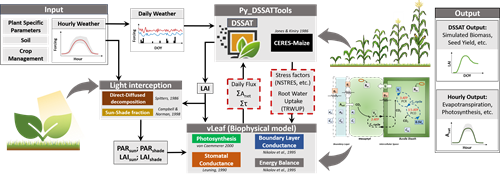
This study presents a novel cross-scale framework, vLeaf@DSSAT, where we couple a process-based leaf model with the CERES-Maize growth model and introduce a two-leaf (sunlit–shaded) canopy representation. The explicit consideration of energy balance makes this framework distinct from similar attempts in the past. CERES-Maize provides daily crop state variables such as leaf area index (LAI), phenology, soil water status, and nitrogen status. Using these, vLeaf then computes hourly net assimilation and transpiration rates for both sunlit and shaded leaf areas. It computes photosynthesis, stomatal conductance, boundary-layer conductance, and leaf energy balance simultaneously in an iterative loop. Root water uptake from CERES-Maize constrains canopy transpiration; vLeaf then reruns under these constraints and updates Tleaf and gas exchange rates. The resulting canopy-scale assimilation from vLeaf drives the biomass accumulation in CERES-Maize on the next day, closing the loop between leaf biophysics and crop growth.

Simulations for climates based on a US Midwest reference site show that neglecting leaf energy balance results in sizeable errors in both carbon gain and water use. For cooler climates, forcing Tleaf = Tair underestimates seasonal carbon gain by ≈ 9% and transpiration by ≈ 30%. For warmer climates, the bias in carbon gain is small, but transpiration is overestimated by 5–10%. These errors can create uncertainty in ranking crop phenotypes with favorable stomatal traits. vLeaf@DSSAT provides a practical approach to testing stomatal manipulation, irrigation strategies, and climate-resilient ideotypes under realistic climate conditions, while also connecting leaf biophysics to field-scale yield and water use.

How to cite: Srivastava, A.: vLeaf@DSSAT: integrating leaf energy balance and biochemistry into CERES-Maize to reassess water-efficient ideotypes, EGU General Assembly 2026, Vienna, Austria, 3–8 May 2026, EGU26-231, https://doi.org/10.5194/egusphere-egu26-231, 2026.

14:51–14:54
|
EGU26-12474
|
Origin: BG9.1
|
ECS
Rajarajan Vetriselvan, Peter Rayner, Antoine Berchet, Philippe Peylin, Elodie Salmon, Marielle Saunois, Juliette Bernard, and Alka Singh

Methane emissions from natural wetlands are the largest and most uncertain component in the global methane budget. Conventionally they are estimated using two main methods. Top-Down methods work by inverting atmospheric concentrations of methane into fluxes, using a chemistry transport model. This is often done by optimizing the scaling factors of the inventory flux maps, but this approach decouples the fluxes from their physics and has limited predictive capabilities. Conversely, Bottom-up methods use biogeochemical models to directly estimate the fluxes, but they are severely affected by the scarcity of in-situ flux observations to calibrate them. To bridge this gap, we present the development and validation of a new fully coupled Methane Data Assimilation System (CH4DAS). This system integrates these two techniques, and provides constraints to the bottom-up model (ie., optimizing its main parameters) from both satellite concentrations and site-level fluxes. Such integration ensures that flux estimates remain consistent with physical drivers, simultaneously addressing data scarcity and enabling predictive capability.

CH4DAS is developed within the Community Inversion Framework (Berchet et al., 2021) and couples SatWetCH4 (Bernard et al., 2025), a simple bottom-up wetland methane model with the LMDz-SACS chemistry-transport model. This system can simultaneously assimilate both satellite concentrations (GOSAT) and site-level in-situ fluxes (FLUXNET-CH4) within a variational assimilation scheme to constrain the model parameters. To address the scale challenges while simultaneously assimilating observations of different streams, we run two instances of SatWetCH4. The first, driven by global forcing is coupled with LMDz-SACS and constrained by Satellite observations. While the second instance driven by site-level forcing is constrained by in-situ fluxes. This way, the shared internal temperature sensitivity parameter Q100 is jointly constrained by two data streams, while site-level and regional base rate parameter K account for data-specific variability.

We mathematically validate the system using an Identical Twin Observing System Simulation Experiment (OSSE), demonstrating its capacity to constrain the control variables. Further, we apply the system to real-world data to demonstrate that the system can successfully reduce the mismatches in the prior to match the spatiotemporal gradients observed by GOSAT, enabling insights on regional CH4 budgets.

How to cite: Vetriselvan, R., Rayner, P., Berchet, A., Peylin, P., Salmon, E., Saunois, M., Bernard, J., and Singh, A.: Beyond Static Fluxes: Constraining parameters of a wetland methane model in a new fully coupled CH4DAS using Satellite Concentrations and In-Situ Fluxes, EGU General Assembly 2026, Vienna, Austria, 3–8 May 2026, EGU26-12474, https://doi.org/10.5194/egusphere-egu26-12474, 2026.

14:54–14:57
|
EGU26-16835
|
Origin: BG10.12
|
ECS
M Niranjan Naik and Vimal Mishra

Water bodies play a crucial role in controlling urban heat by acting as a sink and enhancing evaporative cooling. However, rapid urbanisation in India has led to the progressive encroachment and shrinkage of water bodies, which threatens the urban thermal environment. In this study, we investigate the impact of urban water body encroachment on surrounding temperature using multidecadal Landsat-derived land surface temperature (LST) data at 30 m spatial resolution and water body datasets. The LST of Water bodies and surrounding urban areas within their vicinity are estimated to assess spatiotemporal changes in LST. Our results reveal a substantial increase in LST in urban regions surrounding water bodies in recent decades, indicating a decline in their local cooling effectiveness. Furthermore, encroached water bodies exhibit a pronounced rise in surface water temperature than non-encroached water bodies. The warming of both water surfaces and adjacent urban areas highlights the compound thermal impacts of water body encroachment. The findings indicate that the loss of urban water bodies due to encroachments contributes to the warming of urban areas. The study underscores the importance of protecting and restoring urban water bodies as effective nature-based solutions for mitigating rising urban temperatures and enhancing climate resilience in rapidly growing urban cities.

How to cite: Naik, M. N. and Mishra, V.: Assessing the Impacts of Water Bodies Encroachment on Urban Land Surface Temperature, EGU General Assembly 2026, Vienna, Austria, 3–8 May 2026, EGU26-16835, https://doi.org/10.5194/egusphere-egu26-16835, 2026.

Please check your login data.